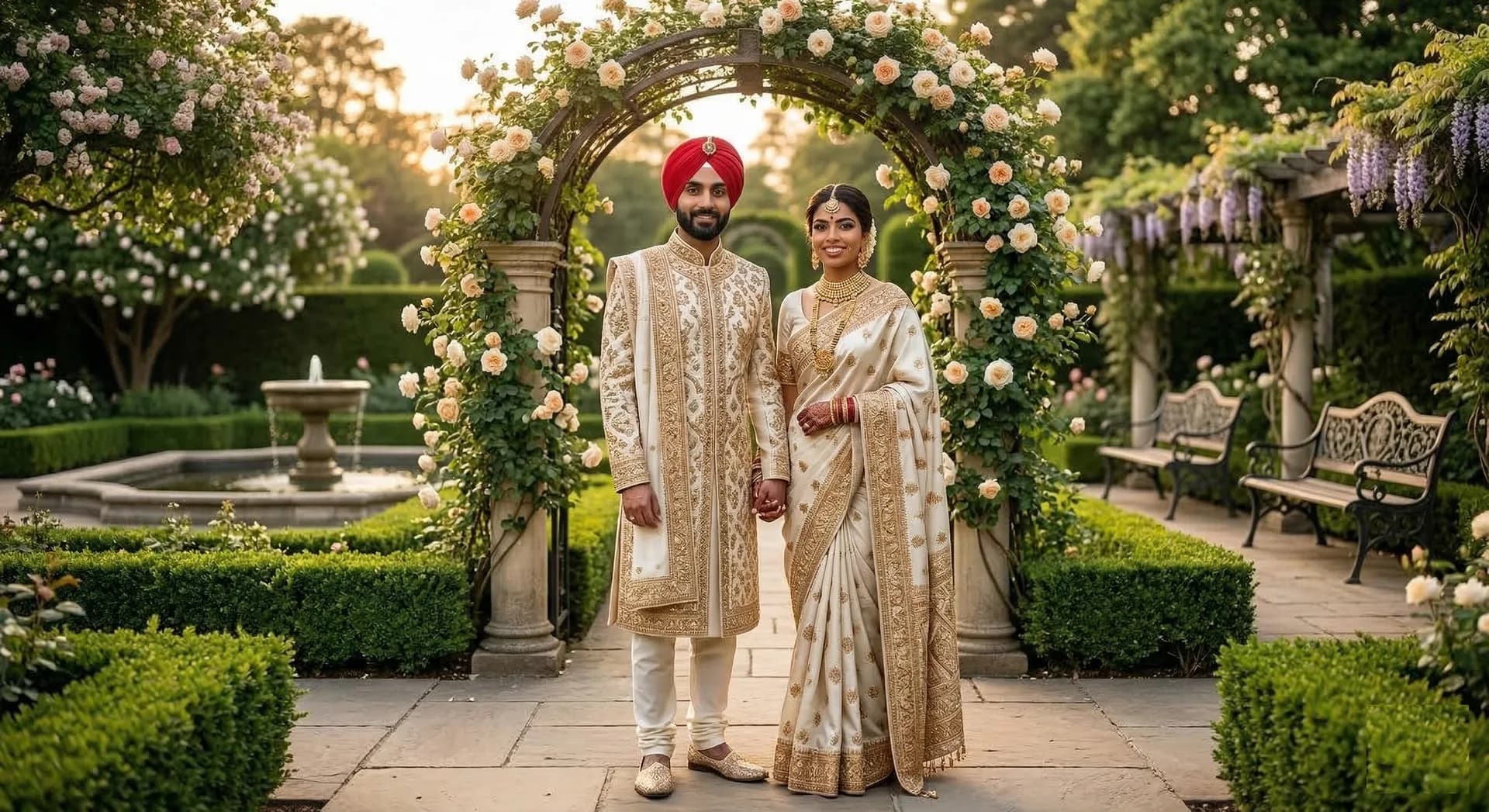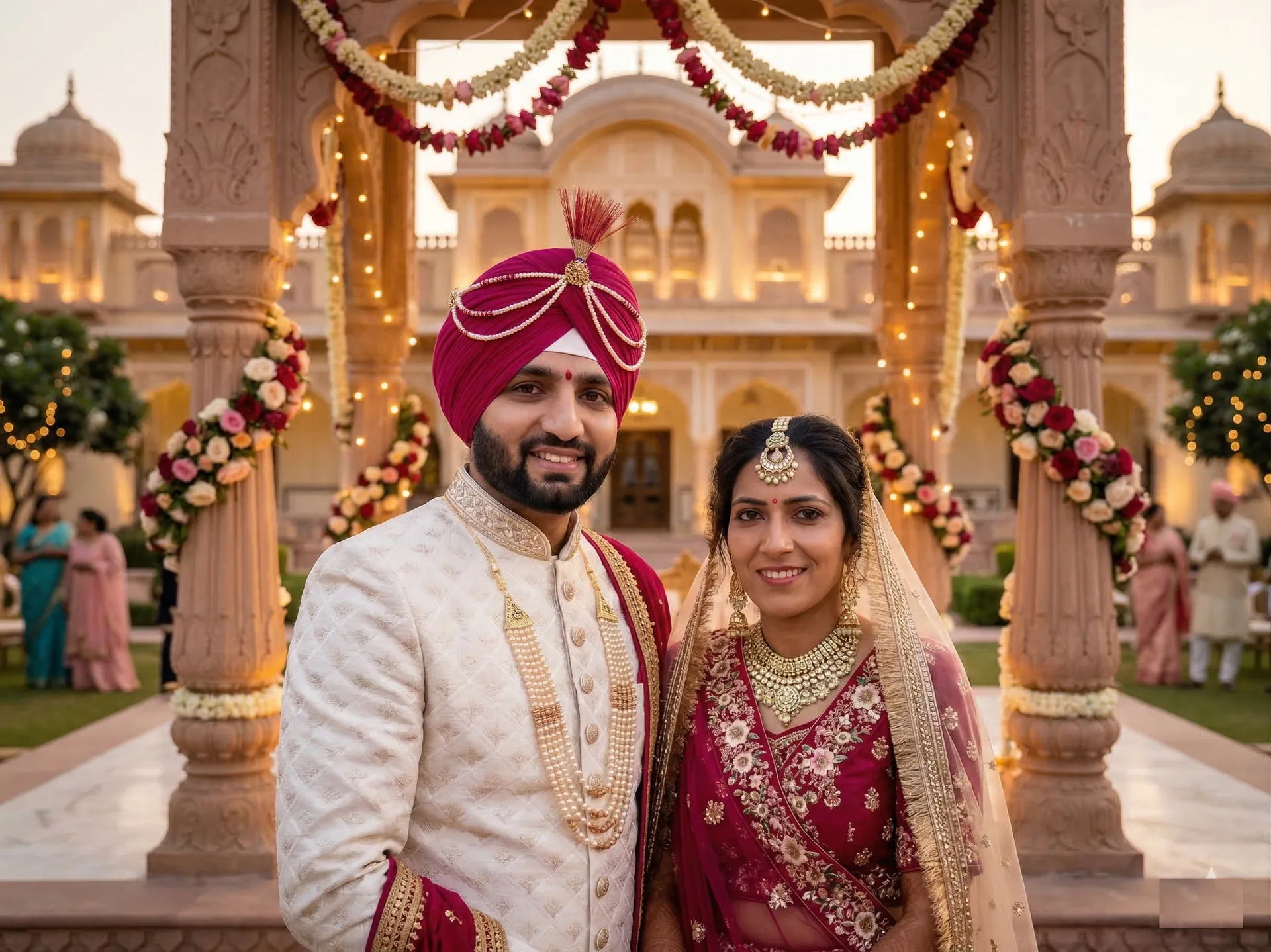
From the roka to the first visit home after the doli: every stage of a Kamboj wedding in the order families usually keep it, what each side does at each one, and where Sikh and Hindu households part ways.
A Kamboj wedding is not one day. It is a run of ceremonies that starts when two families agree to a rishta and ends some days after the bride has moved into her new home, and most of the friction families run into comes from not knowing what is still to come, or from assuming the other side keeps the same order as yours.
This page sets out the stages in the order most families follow, with a few paragraphs on each and a link to a longer article where there is one. It describes Punjabi Sikh and Hindu practice as Kamboj families keep it. None of it is a rulebook. Practice varies by family, by district and by generation, and two households from neighbouring villages can do the same ceremony in a different order and both be right.
Before anything is fixed: the gotra check
No ceremony on this list should happen before the gotras have been compared. The check takes a phone call, and it is the one detail that cannot be repaired after relatives have been told. Most families compare the father’s and the mother’s gotra on both sides, and many go further to the grandmothers. How to do a gotra check sets out the order, and the list of Kamboj gotras gives the 84 and 52 lists with their spelling variants.
Families who follow kundli matching usually have it read at the same stage. Families who do not should say so early, because the other side may assume otherwise; there is a separate piece on kundli matching when the two families disagree.
1. Roka: the search stops
The roka is the first ceremony and the smallest. The word means stopping: both families stop looking at other proposals. It is usually held at home, with only the parents, a sibling or two, the grandparents and the person who brought the rishta. Sweets, dry fruit and fruit are carried, a tikka is put on the groom’s forehead, and shagun is given. In many families the groom’s side gives the bride shagun and a chunni or a suit in return.
Who goes to whose house differs. In a lot of Punjabi households the bride’s side goes to the groom’s home; in others both families meet together, and the couple may exchange rings there and then. What the roka commits each side to, and what it does not, is covered in roka and sagai.
2. Sagai or kurmai: the engagement
The sagai, or kurmai as many Punjabi families say, is the public engagement. It is bigger than the roka, it is announced, and relatives from both sides attend. The bride’s father or an elder puts a tikka on the groom and gives shagun; the groom’s side bring clothes, jewellery and sweets for the bride; in most families today the couple exchange rings and everyone feeds them sweets.
In Sikh households the code of conduct published by the Shiromani Gurdwara Parbandhak Committee says an engagement ceremony is not required. If a family wants one, it says the gathering should be congregational, with the Ardas offered before the Guru Granth Sahib, after which a kirpan, a steel bangle and some sweets may be given to the boy. Many Sikh families hold the kurmai at a gurdwara or at the groom’s home on exactly that pattern, and many add a ring exchange at a separate function.
Some families hold the sagai months before the wedding. Others hold it a week before, or fold it into the chunni ceremony on the same day.
3. Fixing the date, and the decisions that come with it
In many Hindu Kamboj households the date is set by a pandit from the two horoscopes, and the fixed date is the saha. The ceremony itself often falls in the evening or at night, at a muhurat. The Sikh code of conduct is direct on this: it calls consulting horoscopes to choose an auspicious day a sacrilege, and says any day the two sides agree on by mutual consultation should be fixed. Some Sikh families still ask a pandit for the date out of habit; most fix it around the gurdwara’s availability, the harvest and the relatives’ leave.
Fixing the date is also when the decisions that cause arguments later should be made: how many people come with the baraat, who pays for which function, where the ceremony is held, and whether there is one ceremony or two. On the baraat, the Sikh code says the wedding party should be as small as the bride’s people wish, which is a useful line to have in a conversation about numbers. A budget agreed at this point holds better than one argued over in the last week; there is more in a wedding budget that does not end in debt.
4. Chunni chadhana
The groom’s family come to the bride’s home, or to a hall the bride’s side has arranged, with a red or pink chunni, a suit, jewellery, sweets and fruit. The groom’s mother or the senior woman of his family places the chunni over the bride’s head, and with it the bride is accepted as a daughter-in-law of that house. Henna is sometimes put on her palm, and in many families the sagai rings are exchanged on the same day.
Some families hold the chunni at the roka, some at the sagai and some on its own a few weeks before the wedding. Chunni chadhana and the bride’s side covers who comes, what they bring and how the bride’s family host it.
5. The singing nights
In the week or two before the wedding the women of each family gather in the evenings to sing wedding songs to the dholki, and the giddha is danced. Historically these were women’s gatherings at each home, separately; in town families they are now often one ladies’ sangeet at a hired venue, with the men present.
6. Mehndi
Henna is put on the bride’s hands and feet, usually a day or two before the wedding, and on the women of the family alongside her. In many families the groom’s side sends the mehndi. Some brides have the groom’s name or initials hidden in the pattern for him to find later. Many grooms now have a small mehndi at their own home as well.
7. Maiyan and vatna
For a few days before the wedding, or on the last evening only in some families, a paste of turmeric, flour and mustard oil called vatna is rubbed on the bride at her home and the groom at his. Women of the family apply it, the couple are expected to stay at home in old clothes, and they bathe on the wedding morning. Mehndi, maiyan and choora covers the days before the wedding in order.
8. Choora and kaleere
On the wedding morning, or the night before, the bride’s maternal uncle gives her the choora, the set of red and ivory-coloured bangles she will wear for weeks or months afterwards. The mama and mami are at the centre of this ceremony in most families. Afterwards her sisters, cousins and friends tie kaleere, the dangling gold or silver ornaments, to the choora.
How long the choora is worn after the wedding varies widely, from a few weeks to a year, and is usually the bride’s and her in-laws’ decision rather than a fixed rule.
9. Jaggo
On the last night before the wedding, the bride’s family and the groom’s family, each at their own home, hold the jaggo. A woman of the family, often the mami, carries a decorated brass or copper vessel lit with small lamps on her head, and the party go singing and dancing from house to house in the lane or the village, where neighbours meet them with sweets.
In a village it still moves through the streets. In a city it is more often the last hour of the sangeet at the venue.
10. The wedding morning at each home
At both homes the wedding day starts early. In many Hindu and many Sikh households the gharoli is filled: a sister-in-law carries a decorated pitcher to fetch water, traditionally from a temple or a well, for the bride’s or groom’s last bath before the wedding. The maternal uncles often bring the wedding clothes.
At the groom’s home his sister ties the sehra, the veil of flowers or strands that hangs from the turban, and in Hindu households a short puja comes first. His bhabhi lines his eyes with surma. In many families the groom’s sisters feed the mare before he mounts it for the ghodi chadhna, and a young nephew or cousin, the sarbala, dressed like the groom, rides or walks with him.
This is where Sikh households part ways most clearly. The Sikh code of conduct lists, among practices it calls sacrileges at a wedding, decorative headgear and face ornaments, a red thread tied round the wrist, filling a pitcher, havans and the vedi. Some Sikh Kamboj families leave all of these out. Many keep the sehra and the gharoli anyway as Punjabi custom. If the two families are not of one mind about it, the time to find out is when the date is fixed, not on the morning.
11. The baraat and the milni
The groom’s party, the baraat or janj, travels to the bride’s side, traditionally with a dhol and dancing for the last stretch. At the gate the two families meet in the milni: relatives of matching relationship, the two fathers, the two maternal uncles, the two elder brothers, embrace and exchange garlands, and the bride’s side give shagun. At a Sikh wedding a short Ardas is said first, and the code of conduct asks that the two sides greet each other with sacred hymns and the Sikh greeting.
Who is paired with whom in the milni, and whether anything more than a garland is given, is a decision for the two families to make in advance, not at the gate. The baraat and the milni covers the order and the frictions.
12. The ceremony: the Anand Karaj or the pheras
At a Sikh wedding the Anand Karaj is held in the presence of the Guru Granth Sahib, usually at a gurdwara and usually in the morning. The congregation sing, the couple sit facing the scripture with the bride on the groom’s left, and the person conducting the ceremony speaks to them about married life. The bride’s father then places one end of the sash the groom wears across his shoulders in her hand, and the four laavan of the fourth Guru, from the Suhi section of the scripture, are taken one at a time: each is recited, then sung while the couple walk round the Guru Granth Sahib, the groom leading, and they bow when they complete the round. The ceremony closes with verses of the Anand Sahib, the Ardas and karah prasad. The Anand Karaj, explained for families goes through it stage by stage.
At a Hindu wedding the ceremony takes place under a mandap, led by a pandit, at the muhurat fixed for it. The bride’s maternal uncle often brings her to the mandap. The couple exchange garlands, the bride’s parents perform kanyadaan, offerings are made to the fire, and the couple take the pheras around it; the groom then puts sindoor in the bride’s parting and ties the mangalsutra. Under Section 7 of the Hindu Marriage Act, where the rites a family follows include saptapadi, the seven steps taken jointly before the sacred fire, the marriage is complete and binding when the seventh step is taken. The pheras in a Hindu Kamboj wedding explains each stage and where families count them differently.
At both, the bride’s sisters and cousins usually hide the groom’s shoes when he takes them off, and ask for a gift to return them. It is a game. It goes wrong when one side treats the price as a negotiation, so agree the spirit of it in advance.
13. The doli
The farewell is held at the bride’s side, after the meal and the photographs. She throws handfuls of puffed rice back over her head towards her parents’ home as she leaves, her brothers and cousins walk her to the car, which was once a palanquin, and relatives throw coins over it as it goes. It is the moment most families remember, and it is often the hardest part of the day for the bride’s parents.
14. Pani varna and the first evening
When the couple reach the groom’s home, his mother meets them at the door. She circles a vessel of water over their heads several times and sips from it; in many families she is playfully stopped a few times before she is allowed to drink. In many homes mustard oil is poured at the threshold before the bride steps in. Then come the games, most often the ring hidden in a bowl of milky water, and the untying of the gana, the thread tied to the couple’s wrists on the wedding morning. Doli and pani varna covers the farewell and the welcome together.
15. The reception and the first visits
The reception is the groom’s family’s function, held to introduce the bride to their wider circle. It used to be a meal at the groom’s home the day after; now it is often a hall booking in the same week, and families abroad sometimes hold it weeks later in the country where they live.
In many families the bride goes back to her parents’ home for the first time the day after the wedding, or within a few days, usually fetched by her brother; this first return is the phera. Visits to the elders of both families follow, and many couples go to the gurdwara or the temple together in the first week. Registration of the marriage belongs in these days as well, while every document is to hand; register your marriage, and why it matters explains why it should not wait.
Timeline: months and weeks before
- The gotra check, and the kundli for families who follow it, before any visit.
- The roka, at home, within days or weeks of the families agreeing.
- The sagai or kurmai, anything from a few weeks to several months later, depending on the season, the couple’s work and relatives abroad.
- The date fixed, and with it the venue, the baraat size, the guest lists and who pays for what.
- The chunni chadhana, if it is a separate ceremony, often a few weeks before the wedding.
- Bookings: the gurdwara or the pandit, the venue, the caterer, the dhol, the clothes, the jewellery and travel for relatives coming from abroad.
Timeline: the last week
- The singing evenings at each home, or one combined sangeet.
- Maiyan and vatna, for a few days or on the last evening only.
- Mehndi, usually one or two days before the wedding.
- The jaggo, on the last night.
- A final call between the two families to confirm the baraat’s numbers and arrival time, the milni pairs and the order of the day.
Timeline: the wedding day
- At each home in the morning: the choora at the bride’s, where it was not done the night before; the gharoli and the bath at both.
- At the groom’s home: dressing, the sehra, the ghodi chadhna, and the baraat setting off.
- At the bride’s side: the milni at the gate, then tea or breakfast for the baraat.
- The ceremony: the Anand Karaj in the morning, or the pheras in the evening or at night at the muhurat.
- The meal, the photographs, the shoe game and the doli.
- At the groom’s home: pani varna at the door, then the games.
Timeline: the days after
- The reception, the next day or within the week.
- The phera: the bride’s first return to her parents’ home, often the day after.
- Visits to the elders of both families, and to the gurdwara or the temple.
- Registration of the marriage, while the documents and the witnesses are to hand.
Where Sikh and Hindu households differ along the way
- The engagement: optional in the Sikh code of conduct and, where it is held, a congregational gathering with the Ardas; in Hindu households usually a tikka and a ring exchange, sometimes with a puja.
- The date: fixed by horoscope and muhurat in many Hindu households; by mutual agreement in Sikh households following the code, which rejects horoscopes for this purpose.
- The time of day: the Anand Karaj is usually in the morning; the pheras often in the evening or at night.
- Who conducts it: at a Sikh wedding the granthi, with the ragis singing, and the code says whoever conducts the ceremony may be a man or a woman; at a Hindu one the pandit or the family purohit.
- The customs around the ceremony: the sehra, the gana, the gharoli, a havan and the vedi are kept by Hindu families and by many Sikh families, and left out by Sikh families who follow the code strictly.
- Alcohol and the evening function: the code lists drinking liquor among practices it calls sacrileges at a wedding, and no gurdwara will allow it on its premises. Whether a separate evening function serves it is a family decision, and one to agree with the other side early.
- Most of the rest, the roka, the chunni, the mehndi, the maiyan, the choora, the jaggo, the milni, the doli and pani varna, is shared Punjabi custom, kept in both kinds of household with small differences of detail.
When the two families keep different traditions
Sikh and Hindu Kamboj families have married each other for generations, and it rarely causes trouble when it is talked through early. The questions are practical: one ceremony or two, on one day or two; which customs stay in on the wedding morning; and what the household the bride is joining observes day to day. When a Sikh and a Hindu Kamboj family marry goes through each of them.
How districts and families abroad vary
The order above holds across Malwa, Doaba and Majha, the canal belt of Sri Ganganagar and Hanumangarh, the Haryana districts and the Terai settlements, but the detail moves. Village weddings keep the jaggo on the streets and the meal at home; town weddings compress the last three days into a venue booking. Horoscopes carry more weight in some Haryana households than in the canal belt, and the kundli is often sent before the families have met; the Kurukshetra district guide has more on how families in that district handle the kundli.
Families abroad usually compress everything. The roka may happen on a video call, the sagai when the groom or bride visits, and the wedding itself in one long weekend so that relatives can fly in for it. Where the couple will live after the wedding shapes the timing more than custom does; the NRI Kamboj matrimony guide covers what changes when one side lives abroad.
The frictions that come up, and how to avoid them
- Assuming the other family keeps your order. Ask at the roka which ceremonies they hold and roughly when.
- Leaving the baraat size, the milni pairs and the shagun at each step undecided until the last week. Settle them when the date is fixed.
- Gifts that grow into expectations. Customary shagun, clothes and jewellery are one thing; a demand for money or goods is dowry, it is illegal, and refusing a dowry demand explains how to do it without wrecking the rishta. The Sikh code of conduct also says no Sikh should accept a match for a son or daughter for monetary consideration.
- Leaving ceremony questions for the morning itself. Whether the sehra is tied, whether the groom’s party take part in a havan, whether a gurdwara has its own requirements: ask early, and ask the gurdwara or the pandit directly.
- Keeping no list. Write down what each side gave at the roka, the sagai and the chunni. It costs nothing, and if anything ever goes wrong it settles the question without argument; breaking an engagement cleanly explains why.
Where to start
Every one of these stages starts with two families who have checked the gotras and agreed, and the Kamboj rishta guide covers how a match reaches that point, from the biodata to the family meeting. If you are still there, SaathiSutra records each member’s gotra from the 84 and 52 lists and marks any profile in search that shares yours, and how it works explains the rest. The articles linked above go into each ceremony in turn, starting with roka and sagai.
Sources
- Sikh Rehat Maryada (English edition), Article XVIII: Anand Sanskar — Shiromani Gurdwara Parbandhak Committee
The Sikh code of conduct. Supports the points on the optional engagement and the kirpan, steel bangle and sweets given to the boy; horoscopes not to be consulted for the date; the practices it calls sacrileges, including face ornamentation, the red wrist thread, filling a pitcher, havans, the vedi and drinking liquor; the size of the wedding party; the greeting at the milni; the order of the Anand Karaj; and no match for monetary consideration.
- Hindu Marriage Act, 1955, Section 7 — Government of India
Provides that a Hindu marriage may be solemnised by the customary rites of either party, and that where those rites include saptapadi the marriage is complete and binding when the seventh step is taken. Supports the paragraph on the pheras.
Our team answers every message. Reach out and we will sort it out.