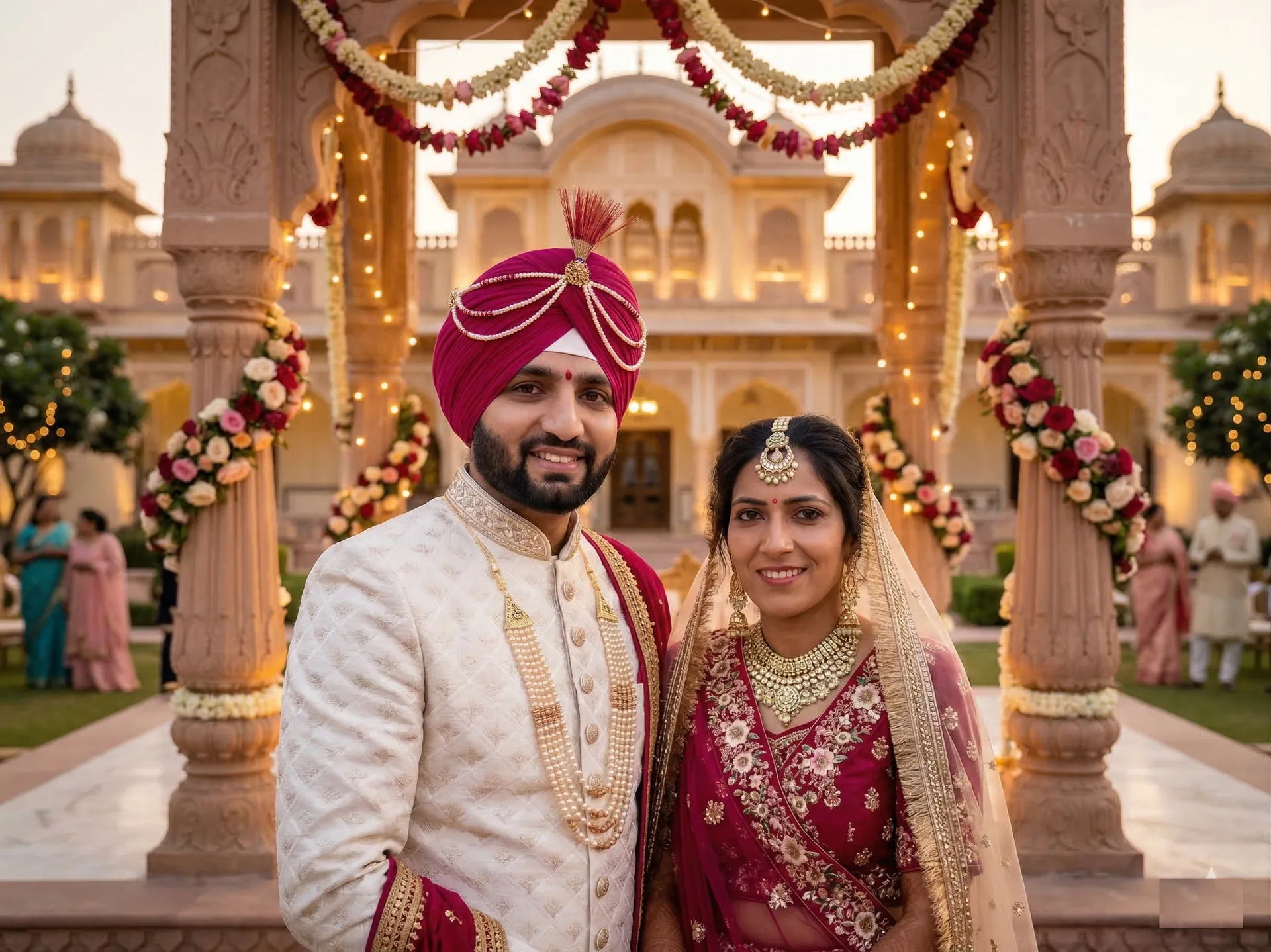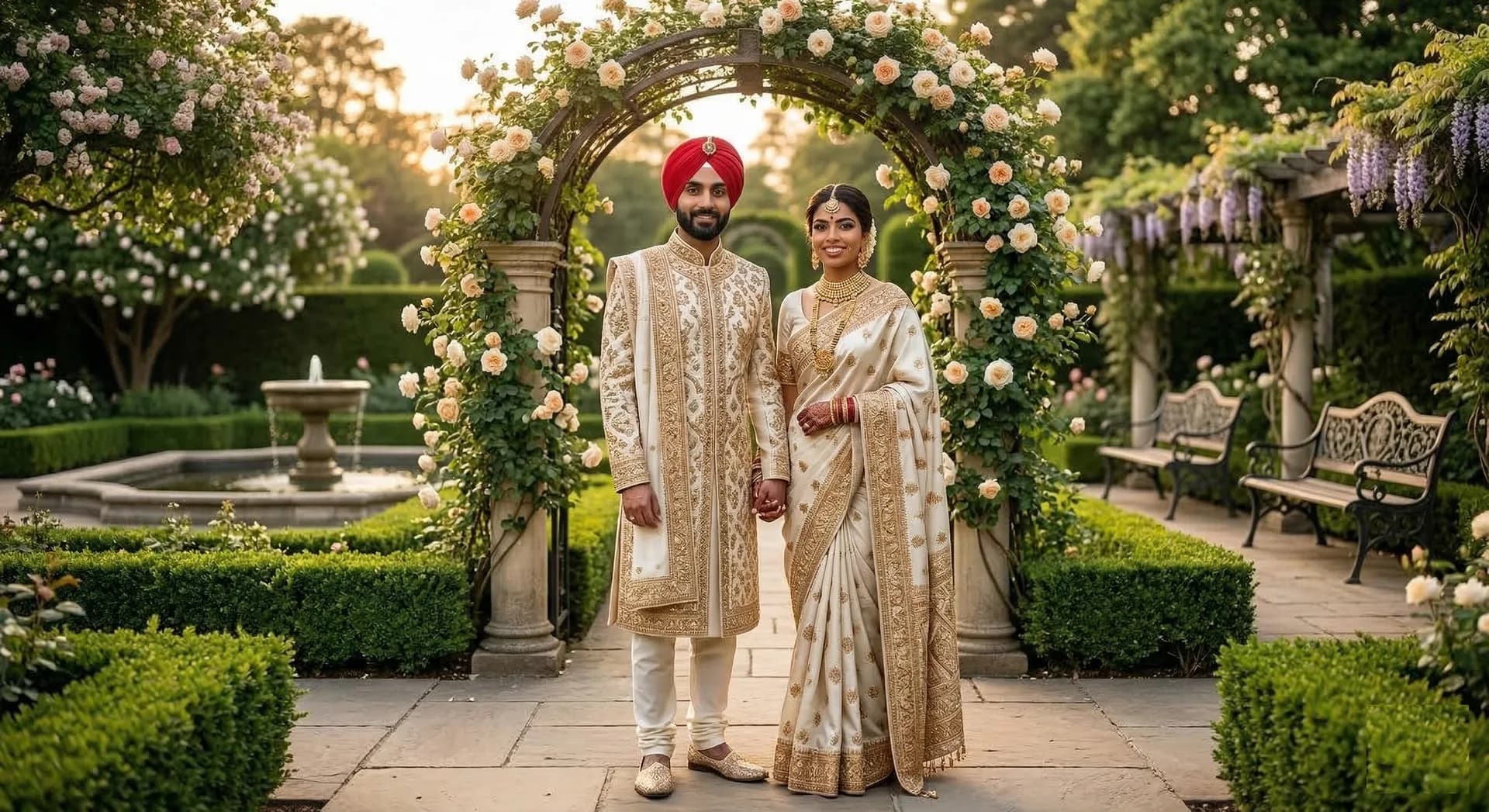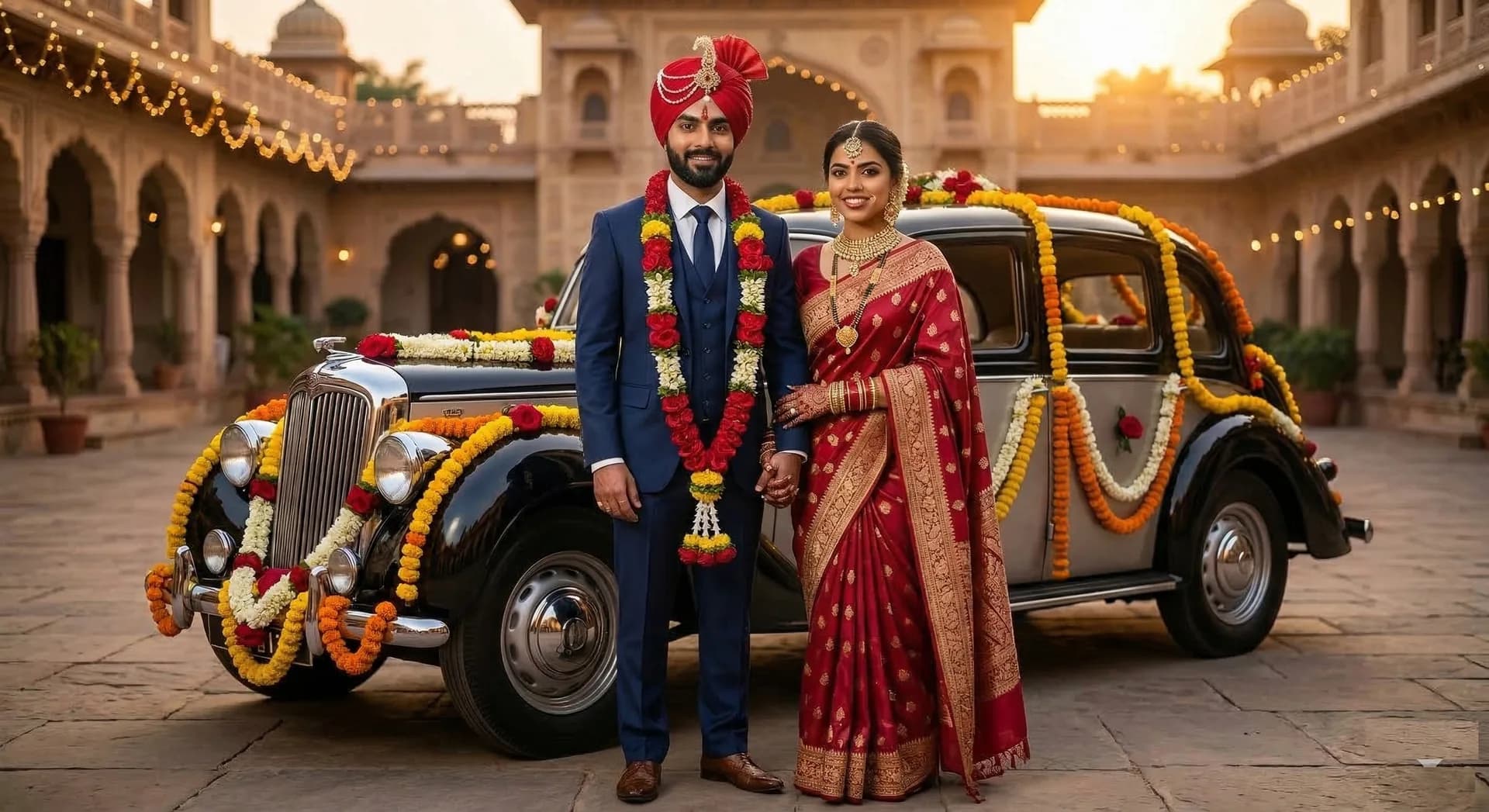
The groom leaves home on a mare with his sehra tied, and at the bride’s gate the two families meet relative by relative. Done well it is the warmest moment of the day; done badly, someone is left out and remembers it. Here is how to plan it.
Every wedding has a moment when the two families stop being hosts and guests and become relatives. In a Punjabi wedding it happens at the bride’s gate. The baraat arrives with the dhol still going, the bride’s family is waiting in a line, and one by one the men of the two sides step forward, embrace and exchange a garland. That is the milni, and for many families it is the part of the day that matters most after the ceremony itself.
It is also the part most often run late, most often left to be organised on the day, and most likely to leave somebody feeling overlooked. This article goes through the groom’s side of the morning — the sehra, the ghodi, setting out — then the arrival and the milni, the meal and, in a Hindu wedding, the jaimala. The last sections are about timing, because a morning Anand Karaj and an evening Hindu wedding put the pressure on the baraat in very different places.
As always, families differ. What follows is common Punjabi Sikh and Hindu practice as Kamboj families keep it, with the variations noted.
At the groom’s home: dressing and the sehra
The groom’s wedding morning starts at home. In many families there is a last vatna and bath, then he dresses in clothes often given by his mama. In a Sikh family there is usually an ardas before he leaves, and some families stop at a gurdwara on the way. In a Hindu family a pandit may perform a puja at home first.
Then comes the sehrabandi. The sehra is a veil of flowers, beads or gold thread tied over the groom’s turban so that it hangs in front of his face, and in most families his sister ties it, with his brothers-in-law and cousins close by. The relatives watching give shagun as they bless him. In many families a young nephew or cousin, the sarbala, is dressed to match the groom and stays at his side for the rest of the day, and his bhabhi lines his eyes with surma and is given shagun for it.
Here Sikh families diverge. The SGPC’s code of conduct lists floral or gilded face ornamentation among the practices it rejects at a Sikh wedding, and some Sikh families leave the sehra out for that reason, the groom going to the Anand Karaj in a turban without one. Many others keep it. It is the groom’s household’s decision, and nobody on the bride’s side should remark on it either way.
The ghodi
The last ceremony at the groom’s home is the ghodi. A decorated mare is brought to the door; the groom’s sisters and cousins feed her and decorate her, and in many families they hold the reins and must be given shagun before they let go. Money is circled over the groom’s head to ward off the evil eye and then given away. The groom mounts, with the sarbala in front or beside him, and the baraat sets out.
In practice, few grooms now ride the whole way. The usual arrangement is a decorated car for the drive and the mare, or a hired one, for the final stretch to the venue, where the baraat forms up and walks the last few hundred metres with the dhol. That last stretch is where the dancing happens, and where the time goes.
The baraat: who goes and how many
The baraat, also called the jann, is the groom’s party: his family, relatives and friends, travelling with him to the bride’s venue. In older practice it was largely men; today women of the groom’s family usually travel with it, though in some families the groom’s mother stays at home to prepare for the bride’s arrival at the end of the day.
The size of the baraat is the bride’s family’s business as much as the groom’s, because the bride’s side receives, seats and feeds it. The SGPC’s code says the marriage party should have as small a number of people as the girl’s family desire. Whatever the family’s tradition, that is a sound rule: the number should have been agreed at the chunni or the sagai, as the chunni chadhana article suggests, and the groom’s side should keep to it. A baraat that arrives with half as many again as agreed has put the bride’s family in an impossible position in front of its own guests.
The arrival
At the bride’s venue her family waits at the entrance, the elders in front. What happens next depends on the kind of wedding.
At a Sikh wedding the baraat usually arrives at the gurdwara, or at the hall where the Anand Karaj will be held. The SGPC’s code says the two sides should greet each other singing sacred hymns and then with the Sikh greeting, “Waheguru ji ka Khalsa, Waheguru ji ki Fateh”. In practice an ardas is commonly said first, and the milni follows it, outside the gurdwara or in its courtyard, before the families go in. The order of ardas and milni varies by gurdwara and family, so ask.
At a Hindu wedding the baraat arrives at the venue, often in the evening. The bride’s mother typically welcomes the groom at the entrance with a tilak and an aarti, and the bride’s sisters and cousins often stretch a ribbon across the entrance and refuse to let him in until he pays to cut it. The bargaining is a game and should stay one; the groom’s side should come with an envelope ready and the bride’s side should not drag it out. The milni follows, and then the jaimala.
Wherever it happens, the bride’s side should have someone at the gate whose only job is to receive the baraat, show the elders where to stand, and start the milni when the groom’s side is ready.
The milni: who meets whom, and in what order
Milni means meeting. A relative from the bride’s side and the matching relative from the groom’s side are called forward by relationship, they embrace, exchange garlands, and the bride’s side gives a gift. Then the next pair. The names are usually called by a granthi, a pandit or a relative with a list.
The common order runs from the most senior relationship downwards, roughly by age:
- The fathers of the bride and groom. Many families begin here; some begin with the grandfathers, as the eldest present, and then come to the fathers.
- The grandfathers, where they have not gone first.
- The mamas, the maternal uncles.
- The chachas and taayas, the father’s brothers, eldest first.
- The phuphars and masars, the husbands of the father’s sisters and the mother’s sisters.
- The brothers of the bride and groom, and then the brothers-in-law, the jijas.
- Cousins and other relatives, if time and the list allow.
Women in the milni
Traditionally the milni was between men. Many families now add the women: the mothers first, then the mamis, chachis and buas, called forward in the same way and exchanging garlands. Some families hold the women’s milni at the gate after the men’s; others hold it inside, more quietly. It is increasingly common and nobody should be surprised by it, but it doubles the list and the gifts, so the two families need to agree whether it is happening before the day, not at the gate.
The gifts
The bride’s side gives each groom’s-side relative a gift as they embrace. Garlands go both ways. Beyond that, families give shagun in an envelope, and many add a blanket, a shawl or a set of clothes, the value usually stepping down with the seniority of the relationship. In some families the groom’s side gives a smaller return gift in each pair.
Two principles keep this from going wrong. The first is consistency: relatives at the same level of relationship should receive the same thing. Nothing causes more talk afterwards than one chacha’s envelope being noticeably thicker than another’s. The second is that the gifts are the bride’s family’s choice. Milni gifts that are asked for, specified or graded by the groom’s side have stopped being gifts. A demand for money or goods in connection with a marriage is dowry, and giving, taking or demanding dowry is an offence under the Dowry Prohibition Act, 1961; refusing a dowry demand covers how to deal with one without wrecking the relationship.
Keep a list of what was given and to whom. It settles any later question, and the rules made under the Dowry Prohibition Act provide for lists of the presents given at a wedding to be kept for exactly this kind of reason.
Agreeing the list so nobody is left out
The milni goes wrong in one predictable way: a relative who expected to be called is not, or is called and finds no counterpart waiting, and stands at the gate while everyone watches. The fix is a list agreed in advance, and it is worth doing a week before the wedding, not on the morning.
- Each family writes its own list by relationship, in the order it wants them called, with names. Fathers, grandfathers, mamas, chachas and taayas, phuphars, masars, brothers, jijas — whatever your family includes.
- Swap the lists and pair them. Where one side has three mamas and the other has one, decide who meets the extra two: another senior relative, or the same man three times. Both are common; neither is an insult if it was agreed.
- Decide who stands in where a relationship is missing. If a father or a mama has died, the family usually asks the next senior man of that line — an elder brother, a chacha, a cousin — and the other side should be told beforehand so the caller does not stumble.
- Settle relatives who belong to both sides. Kamboj families are often already connected by an earlier marriage, and an uncle may be related to the bride and the groom. Agree which side he stands on.
- Fix whether there is a women’s milni, and if so, pair that list too.
- Prepare the gifts against the list. Label each envelope or parcel with the pair it is for, and put one person in charge of handing them over in order.
- Give the caller a clean copy. Whoever announces the pairs — granthi, pandit or relative — should have the final list in large type, with names and relationships, and should not be improvising.
- Have the pairs at the front. Ask every groom’s-side relative on the list to walk near the front of the baraat for the last stretch, so the milni is not held up while someone is fetched from the back.
After the milni: the meal
At a Sikh wedding held in the morning, the baraat is usually given tea and breakfast after the milni and before the Anand Karaj, and lunch is served after the ceremony, at the gurdwara or at a hall. If the Anand Karaj is at a gurdwara, the families go in, sit before the Guru Granth Sahib, and the ceremony runs as described in the Anand Karaj, explained for families. No alcohol or tobacco should come anywhere near a gurdwara, and the SGPC’s code lists drinking liquor among the practices it rejects at a wedding. A groom’s side that has been drinking on the way does the bride’s family no favours at the gurdwara gate.
At a Hindu wedding in the evening, the milni and the jaimala are usually followed by dinner, with the baraat served first by the bride’s family. In some Hindu families the bride’s parents keep a fast until the kanyadaan and do not eat at the dinner at all. The pheras come later, at the muhurat the pandit has fixed, which may be late at night; the pheras in a Hindu Kamboj wedding covers that part.
The jaimala in a Hindu wedding
After the milni, the bride is brought out by her sisters, cousins or brothers, usually to a stage, and the bride and groom exchange garlands. In many families the bride places hers first, as a sign of her choice. The friends on either side traditionally make it difficult, lifting the groom so the bride cannot reach, or the bride so he cannot, and the guests enjoy the contest.
Keep it short and keep it safe. Lifting people on a raised stage in heavy clothes is how ankles get turned. The jaimala is a garland exchange, not a part of the religious ceremony, and it can be done in five minutes. Some Sikh families add a garland exchange at an evening reception; it is not part of the Anand Karaj.
Timing: a morning Anand Karaj
An Anand Karaj is usually held in the morning, and many gurdwaras expect it to be finished by around midday. On a popular date a gurdwara may have more than one wedding booked, and a baraat that arrives late can push the Anand Karaj into the next family’s slot or cut its own short.
The way to plan it is backwards. Start from the time the gurdwara needs the couple seated before the Guru Granth Sahib. Before that comes the milni, then breakfast. Before that, the baraat’s walk from the drop-off point with the dhol. Before that, the drive. Before that, the ghodi, the sehrabandi and dressing at the groom’s home. Write each step down with how long your family thinks it will take, add a margin to each, and the time the groom must be dressed comes out much earlier than anyone expected.
That has consequences the night before. If the groom’s family must be dressed at dawn, its jaggo cannot run until three in the morning. The same is true of the bride, whose choora, dressing and photographs come before the baraat arrives.
Timing: an evening Hindu wedding
An evening wedding gives the groom’s family a gentler morning, but it moves the pressure to the night. The baraat arrives in the evening, the milni and jaimala follow, then dinner, then the pheras at the muhurat. If the muhurat is late, the danger is not that the baraat is late but that the dinner runs on, the elders tire, and the pheras begin with half the guests gone home.
The planning is the same backwards exercise from a different anchor. Start from the muhurat, allow the pandit his time to prepare the mandap, and work back through dinner, the jaimala, the milni and the arrival. If the muhurat is very late, ask the pandit whether the pheras can begin within the auspicious window rather than at its last moment, and decide whether the elders will be given a quiet room to rest.
Keeping the baraat on time
A baraat is late for the same reasons almost every time: the groom was not ready, the cars left in the wrong order, the dancing at the gate went on, and the milni waited for relatives who were still parking. Each of these can be handled.
- Name a timekeeper on the groom’s side, someone senior enough to be listened to, whose job for the morning is the clock.
- Fix how long the dancing at the gate will last, and tell the dhol players when they are booked until. Agree a signal for when it is time to move.
- Send the milni pairs in the first cars, so they are at the front when the baraat reaches the gate.
- Keep one phone line open between the two families’ contacts, with updates every half hour on the morning: leaving, on the way, arrived.
- Do not wait for everyone. The milni starts when the people on the list are present; latecomers join the meal.
- Agree with the photographer what is to be photographed and when. Photographs at the ghodi and the gate are expected; a forty-minute shoot before setting out is not.
- If the venue is far, leave earlier than seems necessary. Traffic on a wedding-season morning in Punjab is not a surprise to anyone.
Families abroad, and baraats that travel far
When the families live in different districts, or the groom’s family is coming from abroad, the baraat often stays the night near the bride’s venue. The bride’s family may then be hosting the baraat for longer than a meal, and that should have been agreed with the guest numbers. Abroad, with venues booked by the hour, the milni is often shorter and the list trimmed to the closest relatives; that is fine if both sides agree it beforehand. The Canada guide and the wider NRI Kamboj matrimony guide cover how families abroad arrange these things.
The short version
- Agree the baraat’s size at the chunni or sagai, and keep to it.
- Agree the milni list, in order and in pairs, a week before.
- Decide whether there is a women’s milni.
- Keep the milni gifts consistent within each level of relationship, and keep a list.
- Work the wedding day backwards from the gurdwara’s slot or the muhurat.
- Name a timekeeper on the groom’s side and a receiver at the bride’s gate.
What comes after
After the ceremony and the meal comes the doli, the bride’s farewell from her family, and the welcome at the groom’s door, which doli and pani varna covers. For the whole wedding in one place, from the roka to the doli, see Kamboj wedding rituals, step by step.
Sources
- Sikh Rehat Maryada (The Code of Sikh Conduct and Conventions), Article XVIII, Anand Sanskar — Shiromani Gurdwara Parbandhak Committee, Amritsar
Clause (i) says the marriage party should be as small as the girl’s family desire and that the two sides should greet each other singing sacred hymns and then with the Sikh greeting; clause (h) lists floral or gilded face ornamentation and drinking liquor among practices the code rejects at a Sikh marriage. Supports the paragraphs on the baraat’s size, the arrival at a Sikh wedding, the sehra and alcohol.
- Dowry Prohibition Act, 1961 — Government of India
Makes giving, taking or demanding dowry an offence, and provides for rules under which lists of the presents given at a wedding are kept. Supports the section on milni gifts.
Our team answers every message. Reach out and we will sort it out.