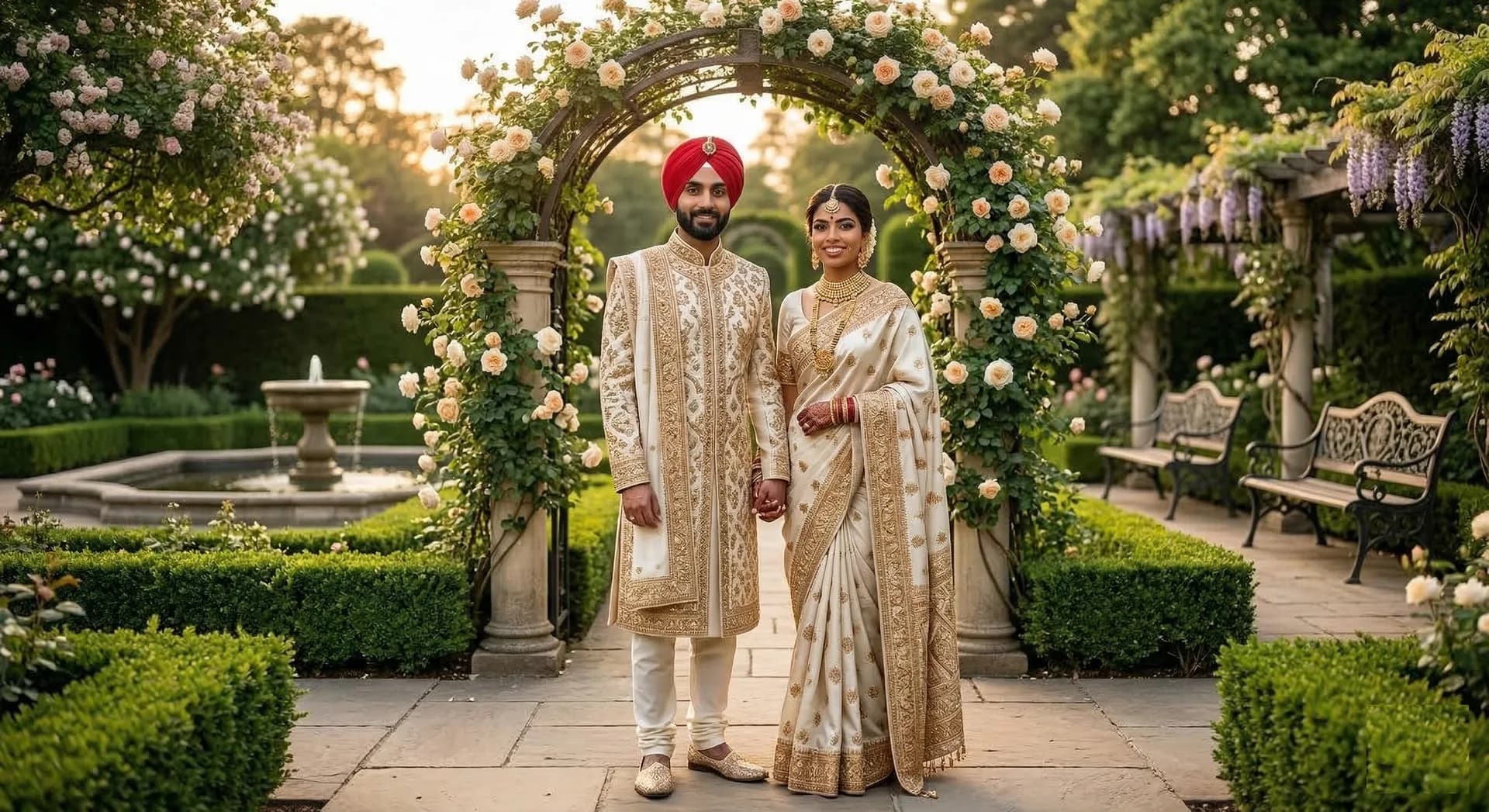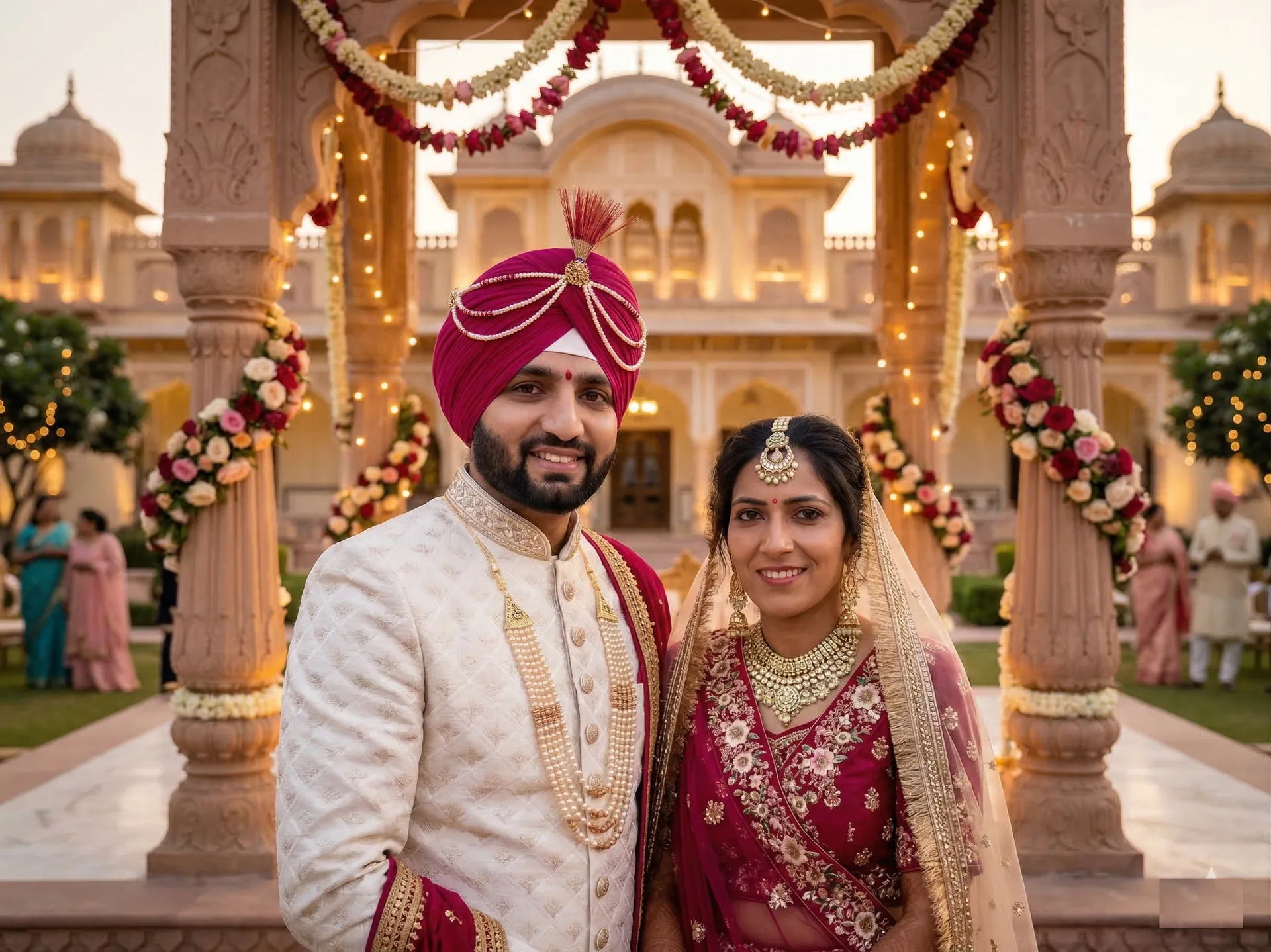
Four laavan, an ardas at each end, and a morning that runs to the gurdwara’s clock. What happens at a Sikh wedding, who does what, what the code asks, and how the marriage is registered afterwards.
In a Sikh Kamboj household the wedding itself is short. The Anand Karaj takes well under an hour, much of it is sung, and the couple say nothing aloud. Everything around it, from the milni at the gurdwara gate to the langar afterwards, is where the planning goes and where the two families need to agree.
This article is for the parents and the couple arranging one, particularly for the first time. It sets out what happens in the darbar hall and in what order, what the Sikh code of conduct published by the Shiromani Gurdwara Parbandhak Committee says about the ceremony, which arrangements have to be made with the gurdwara committee before the date is fixed, and how the marriage is registered afterwards. Practice varies by gurdwara, by family and by district, and where it does we say so rather than pretending there is one correct version. For how the Anand Karaj fits into the whole sequence of functions, from the roka to the doli, see the step-by-step overview of a Kamboj wedding.
What the Anand Karaj is
Anand means bliss, and karaj means a ceremony or an undertaking. The Anand Karaj is the Sikh marriage rite: the bride and groom are married in the presence of the Guru Granth Sahib, before the sangat, by walking around the scripture four times while the four stanzas of the laavan are read and sung. An ardas opens the ceremony and another closes it.
There is no fire, no pandit and no exchange of vows spoken by the couple. Nor is there a horoscope reading to fix the hour. The person conducting it may be the gurdwara’s granthi or another member of the sangat, and the singing is done by ragis or by the congregation together. The couple’s part is to sit, to listen, to bow and to walk.
What the Sikh Rehat Maryada says about it
The Sikh Rehat Maryada is the code of conduct issued by the SGPC in Amritsar. Its English version, published by the SGPC’s Dharam Parchar Committee as The Code of Sikh Conduct and Conventions, deals with marriage in Article XVIII, under the heading Anand Sanskar. Most gurdwara committees, in Punjab and abroad, take it as their reference when a family asks what is and is not allowed. The provisions families most often need to know are these:
- A Sikh’s marriage should be solemnised by Anand marriage rites, and a Sikh man and woman should marry without regard to the other’s caste and descent.
- Persons professing faiths other than the Sikh faith cannot be joined in wedlock by the Anand Karaj ceremony. This is the clause behind the conditions a gurdwara committee sets, and it matters most when one family is Sikh and the other is not.
- An engagement ceremony is not required. If one is held, the code describes a gathering, an ardas before the Guru Granth Sahib, and a kirpan, a steel bangle and some sweets given to the boy.
- Consulting horoscopes to choose an auspicious day is called a sacrilege. Any day that suits both families, fixed by mutual consultation, will do.
- The code lists other practices as sacrileges at a Sikh wedding, among them the floral or gilded face ornament, the red thread round the wrist, performing havans, installing a vedi and drinking liquor.
- The marriage party should be as small as the bride’s family wishes, and the two sides should greet each other with hymns and the Sikh greeting.
- No Sikh should accept a match for a son or daughter for monetary consideration.
- A widow or widower may remarry, and the remarriage may be solemnised in the same way as an Anand marriage.
Where the code and the wedding hall part company
Read against an ordinary Punjabi wedding, some of that list is plainly not what happens. Many Sikh grooms still wear a sehra on the way to the gurdwara, many families still hold the wedding on a date a relative considered favourable, and the evening reception at a marriage palace frequently has a bar. Families know this. The code describes the standard; households keep it to different degrees.
What matters on the day is that the gurdwara committee, the granthi and the ragis apply the code inside the gurdwara, and some apply it more strictly than others. A granthi may ask that the sehra be lifted or removed before the couple sit before the Guru Granth Sahib. A committee may decline to conduct the ceremony if it hears that the baraat arrived drunk. None of this should come as a surprise on the morning. Ask in advance what the gurdwara expects, and tell your own relatives, particularly the younger men in the baraat.
The horoscope clause is the one most likely to cause friction between the two families rather than with the gurdwara. If one side wants a date checked by a pandit and the other side follows the code, settle it the way you would settle any kundli question, early and plainly. There is a separate article on kundli matching when the families disagree.
The morning, in the order it usually runs
Anand Karaj ceremonies are held in the morning in most gurdwaras, and many committees expect them to be finished before midday. The code itself fixes no hour, so this is the gurdwara’s practice rather than a religious requirement, but in practice it sets the whole day: the baraat has to leave early, the milni has to be brief, and breakfast is eaten standing up if the schedule has slipped.
A typical morning runs like this, with variations from one family and one district to the next:
- The baraat arrives at the gurdwara, or at the bride’s family’s chosen place nearby. The groom usually comes on a horse or in a decorated car, depending on the family and the distance.
- The milni: an ardas is said, and the senior men of the two families meet in pairs, usually fathers first, then the maternal uncles, then the paternal uncles and so on, with an embrace and a gift from the bride’s side. The details are in the article on the baraat and the milni.
- Tea and breakfast for the baraat, usually arranged by the bride’s family, either in the langar hall or at a nearby venue.
- Everyone moves into the darbar hall. Shoes come off, heads are covered, and the sangat sits on the floor. The groom sits in front of the Guru Granth Sahib first; the bride is brought in afterwards, usually by her brothers, cousins or female relatives, and sits on his left.
- The ceremony itself, described step by step below.
- Shagun: relatives come forward to bless the couple, put a garland or a note in their hands, and are photographed with them.
- Langar or a meal, and then the onward move to the reception venue or the bride’s home for the doli.
The ceremony, step by step
The code sets out the order of the ceremony itself in some detail, and most gurdwaras follow it closely. In plain terms:
- Kirtan. The ragis, or the congregation together, sing hymns while the couple and the families settle.
- Permission and the first ardas. The person conducting the ceremony seeks the sangat’s permission, asks the couple and both sets of parents or guardians to stand, and offers the ardas for the start of the Anand Karaj.
- The address. The officiant explains to the couple the duties of married life according to the Guru’s teaching, first what they owe each other jointly and then what each owes as husband and as wife, including the regard each should show the other’s parents and relatives.
- The bow. The couple bow before the Guru Granth Sahib to show that they accept what they have been told.
- The palla. The bride’s father, or the relative standing in for him, places in her hand one end of the sash the groom wears over his shoulders. This is the moment families photograph most and one of the few in the ceremony that belongs specifically to the bride’s side.
- The four laavan. The granthi reads the first stanza from the Guru Granth Sahib; the ragis then sing it while the groom, followed by the bride holding the palla, walks around the scripture with it on their right. They bow, stand, and the next stanza is read. Four stanzas, four rounds.
- The Anand Sahib. After the fourth round the couple sit, and the first five and the last stanza of the Anand Sahib are recited.
- The closing ardas, after which karah prasad is distributed. In most gurdwaras a hukamnama is also read from the Guru Granth Sahib before the sangat disperses.
The four laavan
The laavan are a hymn of the fourth Guru in the Suhi measure of the Guru Granth Sahib, on pages 773 and 774. The hymn has four stanzas, which is why there are four rounds and not seven. The code asks the officiant to use the hymn to explain to the couple how a marriage is to be modelled on the love between the individual soul and the Divine, so the address before the laavan and the laavan themselves belong together.
A few practical points that are not in any book but come up at almost every Anand Karaj:
- The bride is often helped around. In many families her brothers and male cousins stand at the corners of the platform and steady her as she walks, particularly if the lehenga is heavy. Agree beforehand who will stand where, so that six cousins do not converge on the same corner.
- The pace is set by the ragis. The couple should not start walking until the stanza is being sung, and should not hurry. If the bride falls behind, the groom waits.
- The palla stays in the bride’s hand throughout. If it slips, someone near her picks it up and gives it back, and the round carries on.
Who does what, from each side
Customs differ between Malwa, Doaba and Majha families, between villages and cities, and between households that have lived in the canal belt or abroad for two generations. Roughly, though, the division of roles at an Anand Karaj looks like this:
- The bride’s family hosts. They book the gurdwara, arrange the ragis and the granthi, pay for the karah prasad and usually for the langar or breakfast, and receive the baraat. The code’s line that the marriage party should be as small as the bride’s family wishes reflects the same principle: she is the host side.
- The bride’s father, or the senior relative if her father is not living, hands her the palla. In some families the maternal uncle has a role in bringing the bride into the darbar hall.
- Both sets of parents stand for the first ardas. Where one parent has died or the parents are separated, tell the granthi in advance whom to call up, so nobody is left standing alone or looking for a cue.
- The groom’s family brings the baraat, keeps it on time and on its best behaviour, and brings the clothes, jewellery and shagun customary in their household for the bride. What is exchanged varies by family and should be agreed between the two mothers, not discovered on the day.
- Gifts are customary; demands are not. The code says no match should be accepted for monetary consideration, and the law says that demanding dowry is an offence. If anything on either side starts to sound like a demand, read refusing a dowry demand before you answer.
What to settle with the gurdwara committee
Every gurdwara has a committee or a manager who takes bookings, and their rules are the ones that apply on the day. Visit in person, preferably both families together or at least with the bride’s father and an elder, two or three months before the date. These are the questions to ask, and to write down the answers to:
- The date and the time slot. In the wedding season a popular gurdwara may hold several Anand Karaj ceremonies in one morning, and each family gets a fixed window.
- Who may be married there. Committees apply the code’s clause on Sikh faith, and what they ask for as evidence varies: some ask that both names carry Singh and Kaur, some that the groom wear a turban, some for a written declaration. Ask directly what they require rather than assuming.
- Documents for the gurdwara’s own certificate. Most gurdwaras issue a marriage certificate after the Anand Karaj, which families later use for registration. Ask which proofs of age, identity and address they want, how many photographs, and whether witnesses must sign.
- The ragis and the granthi. Whether the gurdwara’s own jatha sings or the family may bring one, and what offering is customary for the ragis and the granthi. Ask rather than guess an amount.
- Karah prasad and langar. Whether the family pays for the gurdwara kitchen to make them, whether outside caterers may serve on the premises, and what may and may not be brought in. Alcohol, tobacco and meat are not allowed in any gurdwara.
- Dress and conduct. Heads covered for everyone in the darbar hall, no shoes, and in some gurdwaras a request that the groom’s sehra come off before the ceremony.
- Photography and video. Where cameras may stand, whether drones or lights are allowed, and whether the photographer may stand on the platform at all.
- The venue question. Some committees will not take the Guru Granth Sahib to a marriage palace or a resort for the ceremony at all, and ask that the Anand Karaj happen in the gurdwara. If you have been picturing the laavan at a hotel lawn, ask this before you book the hotel.
Registering the marriage
The Anand Karaj makes the marriage. Registration records it, and the record is what a passport office, a bank, an insurer or a foreign consulate will ask for. The article on registering your marriage covers why it matters; what follows is specific to an Anand Karaj.
The Anand Marriage Act, 1909 declares that marriages duly solemnised by the Sikh ceremony called Anand are good and valid in law. For a century it said nothing about registration. The Anand Marriage (Amendment) Act, 2012 added section 6, which requires each state government to make rules under which the parties to an Anand Karaj may have the marriage entered in a Marriage Register kept by an officer the state appoints. Three points in that section matter to families:
- Registration is for proof. The section says in terms that the validity of an Anand marriage is not affected if no entry is made in the register. An unregistered Anand Karaj is still a marriage; it is just harder to prove.
- The register is evidence. Certified extracts are given to the parties on application and payment of the fee the rules set.
- Once is enough. Parties whose marriage is registered under the Act are not required to register it again under any other law, including a state Act.
Registration in Punjab, and elsewhere
Punjab made its rules in 2016, the Punjab Anand Marriages Registration Rules. Under them the Tehsildar or Naib Tehsildar is the registrar, and the marriage is registered with the registrar for the area where it was solemnised, which for most families is the tehsil where the gurdwara stands. The memorandum is to be presented within three months of the wedding, by the couple or by a parent or relative, with an additional form where one of the parties is a non-resident Indian. Later presentation is allowed, with an affidavit explaining the delay and, after longer periods, the written permission of a senior officer and a further fee. Forms, fees and the documents asked for are set by the rules and can change, so collect the current list from the tehsil office before the wedding rather than after it. Families in Punjab will find more on their own district on the Punjab Kamboj page.
Other states made rules at different times, and some had not made any. In September 2025 the Supreme Court directed every state and union territory that had not notified rules under section 6 to do so within four months. Until a state’s rules are in place, the Court directed that Anand Karaj marriages be received for registration under the marriage registration framework already in force there, without discrimination, and that the certificate record that the marriage was solemnised by the Anand Karaj rite if the couple ask. It also said that no application may be refused only because the rules have not yet been notified, and that any refusal must be reasoned in writing.
There is a second route as well. The Hindu Marriage Act, 1955 applies to Sikhs as well as to Hindus, and many Sikh couples in Punjab, Haryana and Rajasthan have long registered their Anand Karaj under it at the local registrar’s office. Either route gives you a certificate. Pick one, and do not register twice.
Whichever route you use, the papers that are usually needed are the same in substance: proof of age for both parties, proof of address, photographs of the couple and of the ceremony, the invitation card, the gurdwara’s certificate, and witnesses with their own identity documents. Collect the age proofs early, because a mismatch between a school certificate and a passport is easier to fix before the wedding than after it. The separate article on marriage age and documents lists what is accepted.
Families abroad
For a Kamboj family in Canada, the UK, the USA or Australia, the Anand Karaj in the local gurdwara is the religious ceremony; whether it is also the legal marriage depends on the law of the country and on whether the gurdwara or its officiant is authorised to solemnise marriages there. In some places the couple must obtain a licence or complete a civil registration before or after the Anand Karaj. The gurdwara committee will know the local rule. Ask them, then confirm it with the local registry.
Where the wedding takes place in Punjab and one or both of the couple live abroad, register in India before the overseas spouse flies back. A registration attempted with one party on another continent is slower and sometimes impossible without their presence. More on that, and on the other questions overseas rishtas raise, is on the NRI Kamboj matrimony page.
Where only one family is Sikh
Many Kamboj families have Sikh and Hindu branches, and it is common for a rishta to bring a Sikh household and a Hindu one together. The Anand Karaj can still be the wedding, but the gurdwara’s conditions apply to both the bride and the groom, and the code lists the havan and the vedi among practices it does not accept at a Sikh wedding, so a family planning both an Anand Karaj and pheras should tell the committee honestly. There is a full article on when a Sikh and a Hindu Kamboj family marry, and a companion piece on the pheras in a Hindu Kamboj wedding.
A short checklist for the two families
- Before the roka or sagai: confirm that both families expect an Anand Karaj, and whether either also wants a Hindu ceremony.
- Two to three months before: visit the gurdwara, book the slot, and get the committee’s conditions, document list and photography rules in writing or in a note you both keep.
- One month before: brief the photographer, decide who stands for the ardas and who hands the bride the palla, and tell the baraat the gurdwara’s rules on conduct.
- Within the first month after: register the marriage, under the Anand rules or the Hindu Marriage Act, while both of you and your witnesses are in the same place.
Everything above varies by family and by gurdwara, and the committee’s word is the one that counts on the day. Families still at the stage of finding a match can register free on SaathiSutra, where the gotra is chosen from the 84 and 52 lists and search marks any profile that shares yours. The Anand Karaj comes later. The arrangements for it are easier when the two families have talked about it before anyone books a hall.
Sources
- Sikh Rehat Maryada (English version: The Code of Sikh Conduct and Conventions), Section Four, Chapter XI, Article XVIII: Anand Sanskar — Dharam Parchar Committee, Shiromani Gurdwara Parbandhak Committee, Sri Amritsar
The order of the ceremony (kirtan, the opening ardas, the address, the palla, the four laavan, the Anand Sahib and the closing ardas), the clause that persons of other faiths cannot be married by Anand Karaj, and the provisions on engagement, horoscopes, practices called sacrileges, the size of the marriage party, monetary consideration and remarriage. The footnote placing the laavan on pages 773 and 774 is from the same article.
- Anand Marriage Act, 1909, as amended by the Anand Marriage (Amendment) Act, 2012 — Government of India
Section 2 on the validity of marriages solemnised by the Anand ceremony, and section 6, inserted in 2012, on state rules for registration, certified extracts, validity not depending on registration, and no duplicate registration under another law.
- Punjab Anand Marriages Registration Rules, 2016 — Government of Punjab
The Tehsildar or Naib Tehsildar as registrar, registration where the marriage was solemnised, the three-month period for the memorandum and the conditions for late presentation. Read in a reproduction of the notification rather than the Gazette copy; confirm current forms and fees at the tehsil office.
- Supreme Court of India, judgment of 4 September 2025 on Anand Karaj registration rules (2025 INSC 1127) — Supreme Court of India
The directions that states and union territories without section 6 rules make them within four months, that meanwhile Anand Karaj marriages be received for registration under the existing framework and the rite recorded on request, and that no application be refused only for want of rules.
- Hindu Marriage Act, 1955 — Government of India
Applies to Sikhs as well as Hindus (section 2), and provides for registration through state rules (section 8): the second route by which an Anand Karaj is commonly registered.
Our team answers every message. Reach out and we will sort it out.