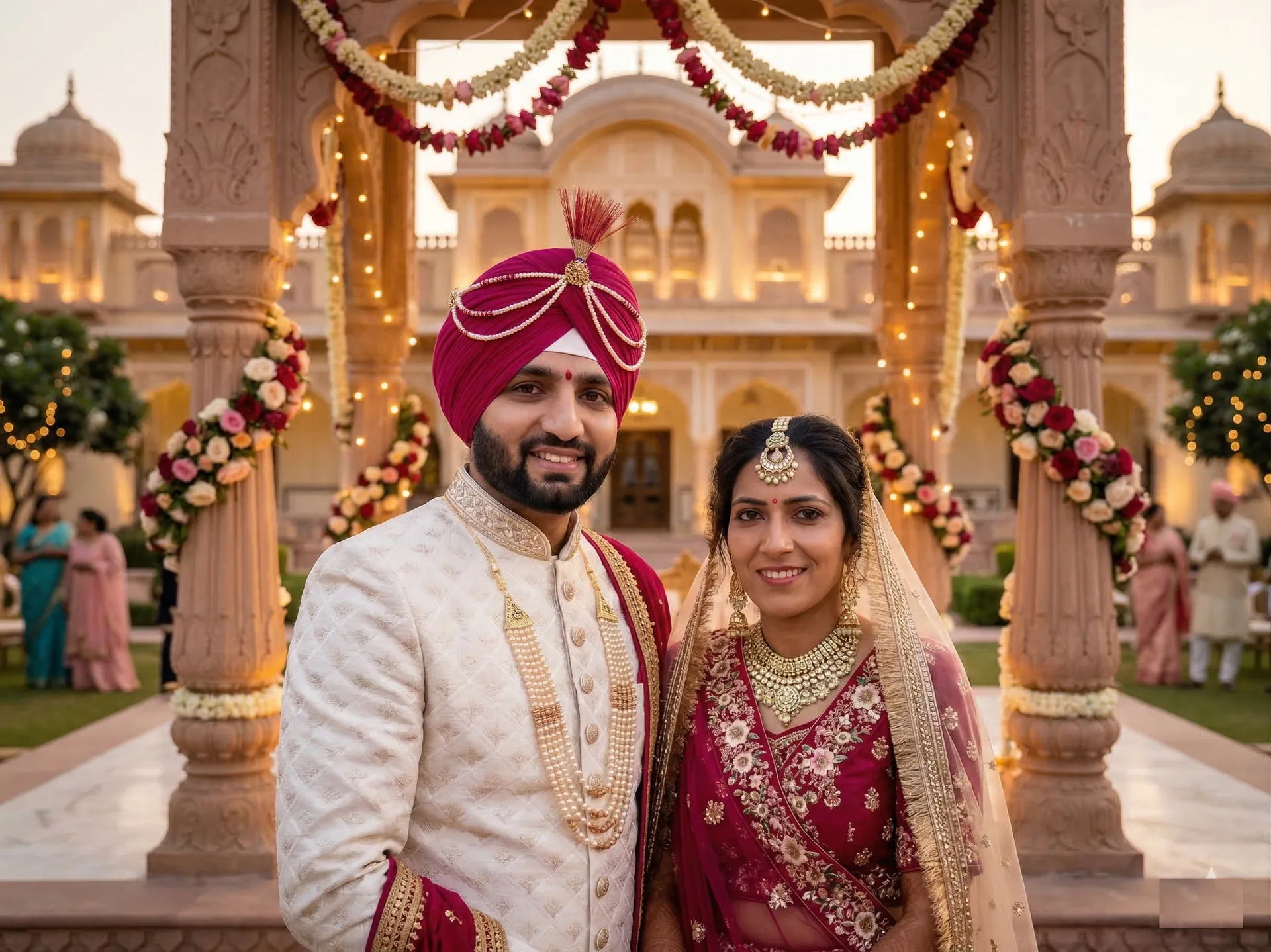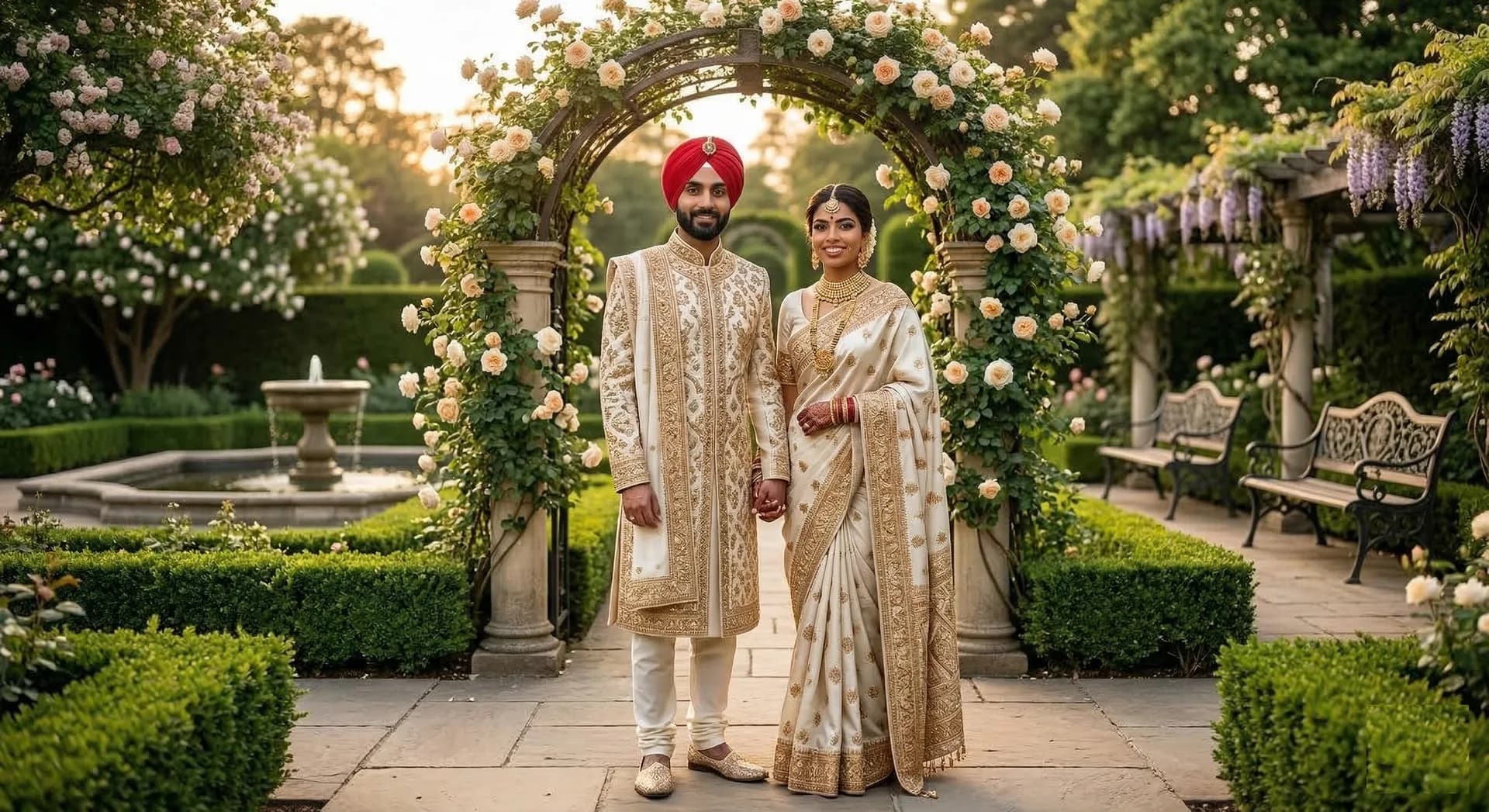
Kanyadaan, the rounds of the sacred fire, the seven steps and the sindoor. What happens at the mandap, who from each side does what, and the exact moment the law treats the marriage as complete.
In a Hindu Kamboj wedding the part everyone remembers is the evening at the mandap: the fire, the pandit’s Sanskrit, the knot in the bride’s chunni, the rounds and the steps. It is also the part the families have least practice at. A father may have been at a hundred weddings and never once been the one asked to perform the kanyadaan.
This article walks through the ceremony at the mandap as Punjabi Hindu families generally hold it, from the fixing of the muhurat to the sindoor, with what each side does and what has to be decided before the day. It also covers one legal point families are often vague about, which is the moment the Hindu Marriage Act treats the marriage as complete. Practice varies by family, by pandit and by district, between Haryana and the canal belt and between India and families abroad, and we say so where it does. For where the pheras sit among the other functions, see the step-by-step overview of a Kamboj wedding.
The pandit and the muhurat
Most Hindu families fix the wedding date with a pandit, who looks at the horoscopes of the bride and groom and names a muhurat: an auspicious date, and within it a time, often called the lagan, at which the main rites should take place. In many Punjabi Hindu weddings that time falls late in the evening or at night, and the lagan can be well after midnight. That single fact shapes the day. The baraat, the dinner, the photographers and the guests who have to drive home all have to be planned around it.
Who chooses the pandit is the first decision. The usual starting point is that the bride’s family hosts the wedding and their family pandit conducts the ceremony, with the groom’s family pandit consulted on the date and sometimes present. Where both families have a pandit they trust, agree early which one will conduct the rites and which one will advise, and introduce them to each other. Two priests who have not spoken before the evening will sometimes disagree about the order of the rites at the mandap, in front of the guests.
How much weight the horoscope carries varies a great deal. Some families will not move without it; others ask the pandit only for a convenient evening. If the two families differ on this, the conversation belongs before the roka, not after the cards are printed. There is a separate article on kundli matching when the families disagree.
What has to be at the mandap
The pandit will give the bride’s family a list of what is needed, and it differs from one pandit to the next. Ask for the list a month ahead, not the week before, and ask who is buying what. Commonly it includes:
- The havan kund for the fire, wood, ghee and havan samagri, and something to keep the fire going through a long ceremony.
- Rice, puffed rice, flowers, betel leaves and nuts, a coconut, a kalash of water, red thread, turmeric and kumkum.
- Seating for the bride, the groom, the bride’s parents and the pandit, and a cloth or chunni for the knot that ties the couple together.
- The sindoor and, in families that use one, the mangalsutra, which are usually brought by the groom’s side.
- Whatever the pandit uses for the seven steps, which in some families is a row of small heaps of rice or a stone the bride touches with her foot.
The ceremony at the mandap, in order
The order below is common in Punjabi Hindu weddings, but pandits differ, and some combine or reorder steps. Ask yours to walk both families through his sequence a few days before.
- The baraat arrives, the milni is held, and in most weddings the couple exchange garlands at the jaimala. These belong to the reception of the groom’s family and are covered in the article on the baraat and the milni.
- At the mandap the pandit begins with an invocation, usually a puja to Ganesh, and the bride’s parents take part.
- Kanyadaan: the bride’s parents give her hand into the groom’s.
- The knot: the end of the bride’s chunni or sari is tied to the groom’s scarf or patka, and stays tied through the rounds.
- The fire is lit and offerings of ghee and samagri are made into it with mantras.
- The rounds of the fire, the pheras, and the seven steps, the saptapadi, described below.
- The sindoor and, in families that observe it, the mangalsutra. The bride moves to sit on the groom’s left.
- The elders bless the couple, and the pandit closes the ceremony.
Kanyadaan
Kanyadaan, the giving of the daughter, is performed by the bride’s parents. The pandit places the bride’s right hand in the groom’s, with the parents’ hands holding or beneath them, and water or other offerings are poured over the joined hands while he recites the mantras. In many families the bride’s parents sit at the mandap through the whole of this part and do not leave until it is done.
If the bride’s father has died, the kanyadaan is usually performed by her mother, or by an uncle and aunt or an elder brother and his wife. Families should decide this calmly and in advance, not leave the pandit to ask at the mandap who will sit. The same is true when the parents are separated. A short conversation a week before spares the bride a difficult moment in front of three hundred guests.
Some families today are uneasy about the idea of a daughter being given, and some pandits will describe the rite in other words or let the couple’s families perform it jointly. That is for the families and their pandit to settle between them. What we would say is only this: decide it before the evening, and tell the other family what you have decided, because a change made at the mandap reads as a statement whether or not one was intended.
The pheras: four rounds or seven
Phera simply means a round. At the heart of the Hindu ceremony the couple, tied together, walk around the sacred fire while the pandit recites, and the fire is treated as the witness to the marriage.
How many rounds a Punjabi Hindu family takes is not settled, and families should not assume the other side does it the same way. Some families take seven rounds of the fire. Others take four rounds and treat the seven steps of the saptapadi as a separate rite performed afterwards. Who leads in which round also differs between families and pandits. We looked for an authoritative account of a single Punjabi practice and did not find one, so we will not invent one here.
The practical advice is short. Ask your pandit what your family has done before, ask the other family what they expect, and if the two differ, let the conducting pandit explain his practice to both before the day. This is rarely a real disagreement; it becomes one only when an aunt counts the rounds aloud at the mandap and announces a mistake.
During the rounds the bride is often steadied by her brothers or cousins, the ends of the knot are watched so they do not come undone, and in many north Indian ceremonies the bride’s brother pours puffed rice into her hands for an offering into the fire. Whether your family includes that, and which brother does it, is worth deciding beforehand so that the right person is standing close to the mandap at the right time.
The saptapadi and the vows
Saptapadi means seven steps. The bride and groom take seven steps together, beside or around the fire, while the pandit recites a mantra for each step. The mantras come from the grihya sutras, old Sanskrit manuals of household rites, and each step is tied to a blessing for the life the couple are beginning. The seventh step is the one that speaks of friendship: the two ask to be companions to each other.
Most pandits now explain the meaning of each step in Hindi or Punjabi as they go, and some ask the couple to repeat a short promise after them. The wording differs from pandit to pandit, so no single list of the seven vows is the correct one. If you would like the meaning explained, or would like it short, tell the pandit in advance.
In many north Indian ceremonies there are also the vachans: promises the bride asks the groom to make before she agrees to move from his right side to his left. Not every Punjabi pandit includes them, and their wording too varies. Families that want them should ask.
Whichever form your ceremony takes, this is the part not to hurry. When a ceremony is running late it is tempting to ask the pandit to shorten things, and the steps are what get compressed. For reasons explained under the legal point below, the saptapadi is the one rite in the evening that the law specifically names.
Sindoor and mangalsutra
After the steps, in families that observe it, the groom applies sindoor to the parting of the bride’s hair. It is the visible sign of a married woman in much of north India, and in many households the bride’s chunni is then drawn over her head by the groom or by an elder from his side.
The mangalsutra, a necklace of black beads usually with a gold pendant, is tied or placed around the bride’s neck by the groom. Not every Punjabi Hindu family has it in its own older practice, and many now include it. Both are normally brought by the groom’s family. Agree between the two mothers who is bringing what, so that the pandit is not waiting at the mandap for a box that is still in the car.
The bride then sits on the groom’s left, and the couple take the blessings of the elders, touching the feet of both sets of parents and grandparents.
Around the mandap
Several Punjabi customs happen in the same hours and belong to the same evening, even though they are not part of the rite itself:
- The choora. The bride has usually worn the choora, the set of red and white bangles, since the morning ceremony at her home, often given by her maternal uncle. That and the maiyan are covered in the article on mehndi, maiyan and choora.
- Joota chupai. While the groom’s shoes are off at the mandap, the bride’s sisters and cousins hide them and ask for a sum to give them back. It is a game, and it goes best when the groom’s side has been told roughly what to expect and treats it as one.
- Gifts. Clothes, jewellery and shagun pass between the families over the wedding, in the forms customary in each household. Gifts are customary; demands are not, and asking for dowry is an offence. If anything starts to sound like a demand, read refusing a dowry demand.
- The pandit’s dakshina. Agree in advance with the pandit what offering is customary, and who on the bride’s side is to hand it to him, so that it is not left to whoever happens to be holding an envelope.
When the marriage is complete: section 7 of the Hindu Marriage Act
Section 7 of the Hindu Marriage Act, 1955 deals with the ceremonies for a Hindu marriage. It does two things. First, it says that a Hindu marriage may be solemnised in accordance with the customary rites and ceremonies of either party. The Act does not prescribe a fixed ritual, a fixed number of rounds or a particular kind of priest; the rites are the customary ones of the bride’s or the groom’s side.
Second, it says that where those rites and ceremonies include the saptapadi, which the section describes as the taking of seven steps by the bridegroom and the bride jointly before the sacred fire, the marriage becomes complete and binding when the seventh step is taken.
In plain terms: in a ceremony that includes the saptapadi, the jaimala does not make the marriage, the kanyadaan does not make it, and the sindoor does not make it. The seventh step does. That is why the steps should be done fully and not dropped when the evening runs late, and why both families should know which part of their ceremony the saptapadi is.
The Act also applies to Sikhs, which matters when one family is Sikh and the other Hindu. That situation has its own article, and the Sikh ceremony is covered in the Anand Karaj, explained for families.
Registering it afterwards
The ceremony makes the marriage. Section 8 of the same Act provides for registering it under rules made by each state, and several states, Punjab and Rajasthan among them, have made registration compulsory by their own Acts. Registration does not create a marriage that the ceremony did not, but it is the proof every office will ask for: a passport, a spouse visa, a bank nomination, an inheritance.
Do it within the first month, while both of you and your witnesses are in the same place. You will usually need proof of age and address for both, photographs of the ceremony, the invitation card and witnesses with their identity documents. The article on registering your marriage explains what the certificate protects, and the separate article on marriage age and documents lists the age proofs that are accepted.
What to decide in advance, and who decides it
- The date and the lagan: the bride’s family, with their pandit, after hearing the groom’s family on dates that do not work for them.
- Which pandit conducts the rites, and whether the other family’s pandit takes part.
- Who performs the kanyadaan, particularly where a parent has died or the parents live apart.
- How many rounds of the fire, how the saptapadi is done, and whether the vachans are included. The conducting pandit explains; the families agree.
- Whether sindoor and the mangalsutra are part of the ceremony, and who brings them.
- Which brother or cousin stands at the mandap for the puffed rice, if your family has that rite, and who steadies the bride.
- How long the ceremony should take, and what to do if the schedule slips. Shorten the dinner or the photographs, not the steps.
Where families differ
In parts of Haryana the horoscope tends to carry more weight than many families in the canal belt of Sri Ganganagar and Abohar expect, and within a single district one household’s practice at the mandap can differ from the next. Families in Haryana arranging a rishta with a family in Punjab or Rajasthan should talk through the ceremony as early as they talk about the date.
Families abroad face a different set of questions. A temple hall or a banquet venue may restrict an open fire indoors, and the pandit may need to bring a covered havan kund or keep the fire small. The religious ceremony may not be the legal marriage in that country, which may require a civil registration or a licence before or after it. Ask the venue and the local registry early. The NRI Kamboj matrimony page covers the other questions overseas rishtas raise.
And in families where one side is Hindu and the other Sikh, it is common to hold an Anand Karaj in the morning and pheras in the evening, or on separate days. That brings its own conditions from the gurdwara committee, and they are worth knowing before you plan two ceremonies.
None of this needs to be complicated. It needs the two families and the pandit to have spoken before the evening, so that on the night the only people improvising are the cousins hiding the shoes. Families still at the stage of finding a match can register free on SaathiSutra, record the gotra from the 84 and 52 lists, and see any same-gotra profile marked in search before the first call. After the pheras comes the farewell, which has its own article on the doli and pani varna.
Sources
- Hindu Marriage Act, 1955, sections 2, 7 and 8 — Government of India
Section 7(1): a Hindu marriage may be solemnised in accordance with the customary rites and ceremonies of either party. Section 7(2): where those rites include the saptapadi, the marriage becomes complete and binding when the seventh step is taken. Section 2 extends the Act to Sikhs, and section 8 provides for registration under state rules.
Our team answers every message. Reach out and we will sort it out.