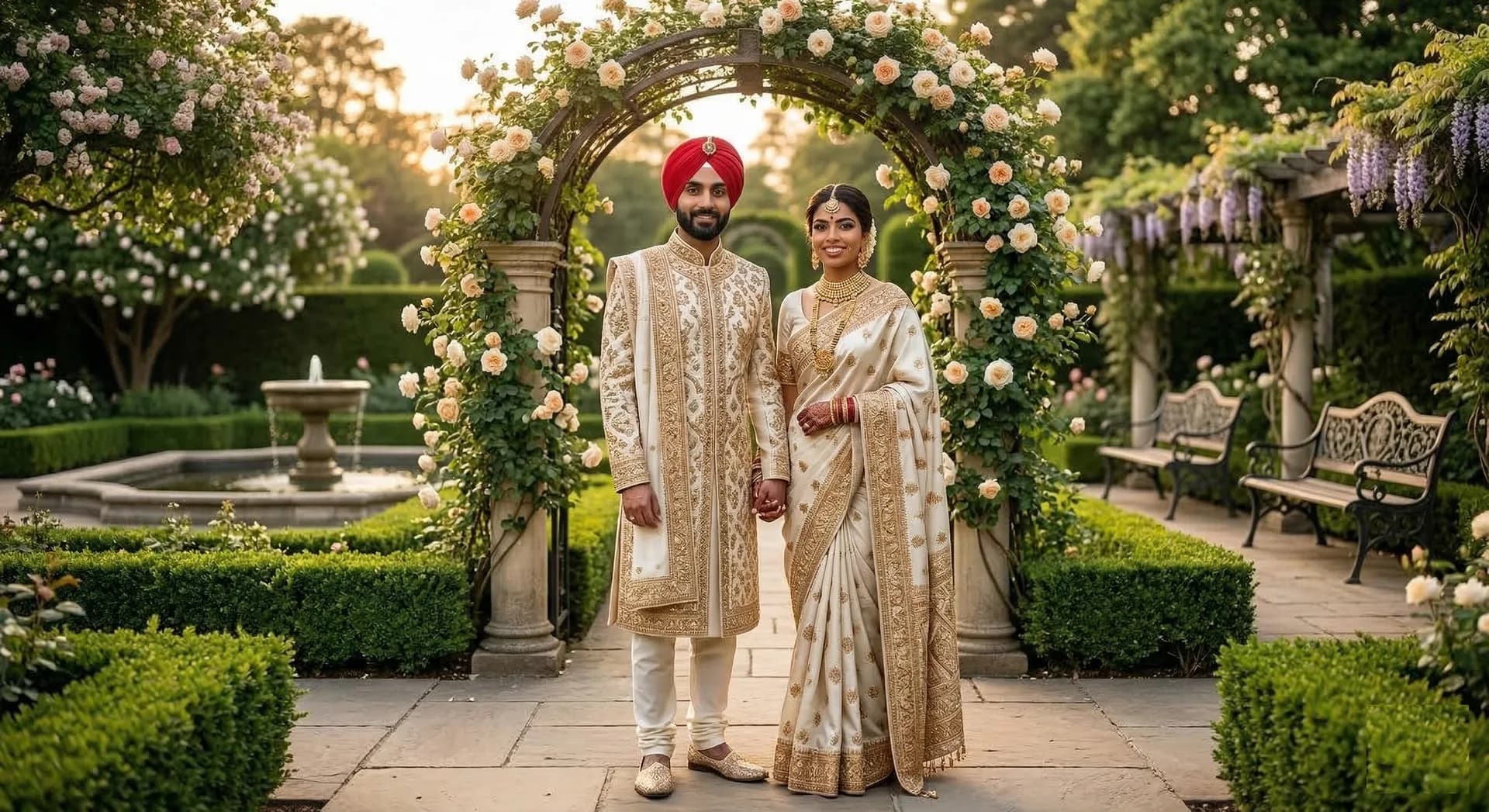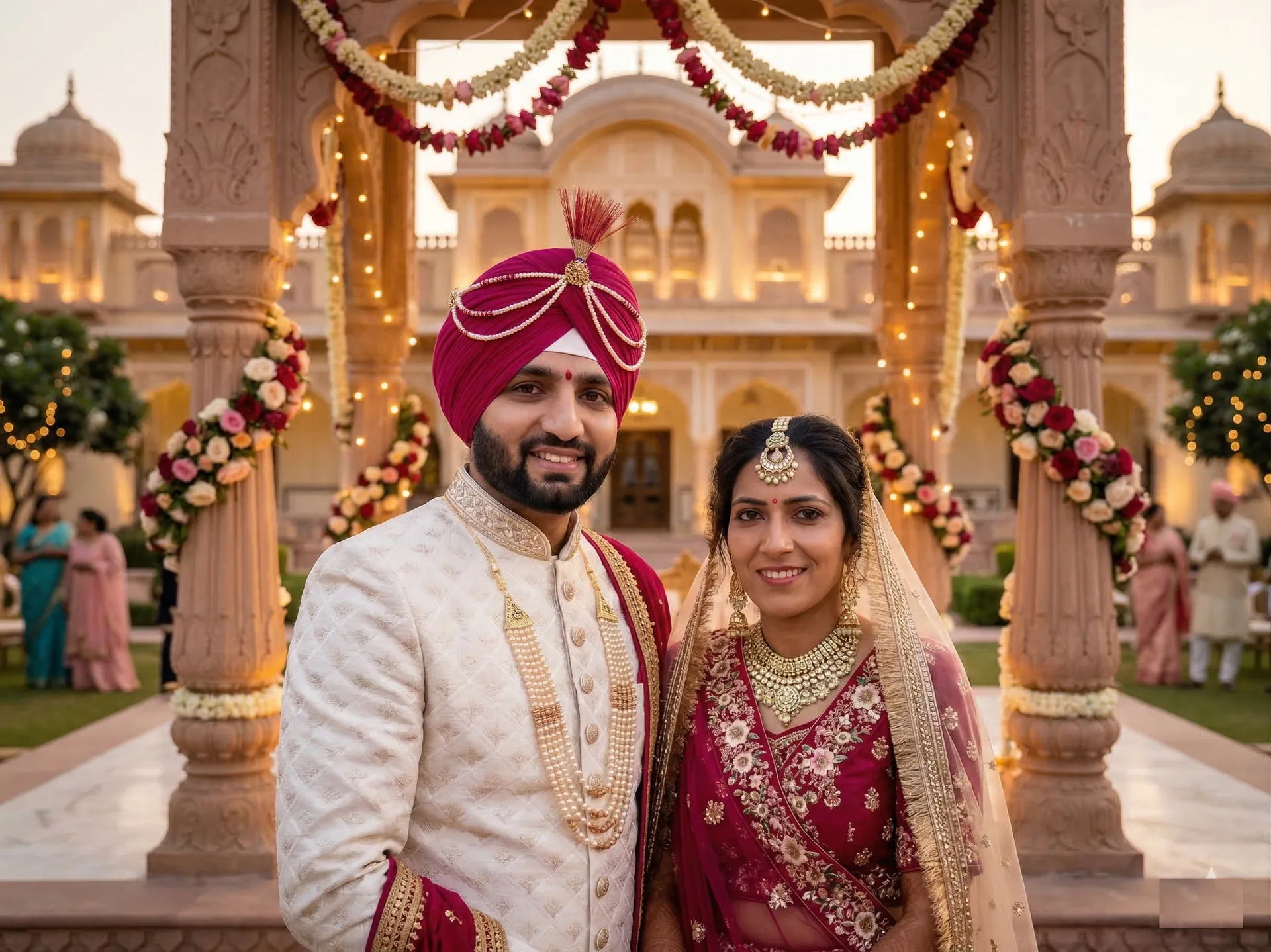
For a few days before the wedding, two houses run the same rituals in parallel: turmeric paste, a red thread, henna, a night of lamps and songs, and on the last morning the bride’s red bangles from her mama. Here is the order, who does what, and how to keep both homes on one clock.
The wedding day gets the photographs, but in most Punjabi homes the days before it are the ones people remember. The house fills with relatives, the women sing late into the night, the bride or groom is rubbed with turmeric paste and kept indoors, and on the last night a lamp-lit pot is carried through the lanes. Then, on the wedding morning, the bride’s maternal uncle slides a set of red and white bangles onto her wrists and the day begins.
All of this happens twice. The bride’s family runs its functions in its own home and the groom’s family runs much the same set in theirs, often on the same days, sometimes in different towns or different countries. This article goes through each ceremony in roughly the order families hold them, says who usually does what, and then turns to the part nobody writes down: keeping two households on one timetable.
Practice varies by family, district and generation. What follows is the common shape of Punjabi Sikh and Hindu practice as Kamboj families keep it, not a rule any family must follow.
The usual order, in brief
The sequence below is the one most families describe. Several of these can fall on the same day, and families move them around freely to suit travel and venues.
- The nanke — the maternal family — arrive, usually a day or two before, bringing their gifts.
- Maiyan begins: the vatna, a turmeric paste, is applied in each home. In some families it is done once, in others on several days running.
- The gana, a red thread, is tied on the wrist in families that keep it.
- Mehndi, usually the night before the wedding or the night before that.
- The jaggo, late on the night before the wedding.
- The wedding morning: a last vatna and bath in many homes; for the bride, the choora and the kalire; for the groom, his wedding clothes, the sehra and the ghodi.
The nanke arrive
The mother’s side of the family carries a particular share of the wedding week, and in most families its arrival is an occasion in itself. The mama and mami, the nana and nani if they are living, and the mother’s sisters arrive with what is often called the nanki shak: clothes, jewellery and cash for the bride or groom and gifts for the household.
Much of what follows depends on them. In many families the mama gives the bride her choora and the groom his wedding clothes, and the mami carries the jaggo. If the maternal family is abroad or cannot come, decide early who will take each of those roles, and tell that person, rather than leaving it to be sorted out on the morning in front of everyone.
Maiyan and the vatna
Maiyan is the ceremony of the vatna: a paste of turmeric, flour and mustard oil rubbed onto the face, arms and legs of the bride in her home and the groom in his. The women of the household apply it, led in most families by the mother, with married women of the family and the biradari taking turns. Songs are sung throughout, and sweets are handed round at the end.
The bride or groom usually sits on a low wooden patri, and in many homes four women of the family hold a red cloth above them while the paste is applied. Afterwards they bathe. Families describe the paste as a cleansing and a preparation for marriage, and nobody needs a better reason than that.
How many days the maiyan runs is one of the widest variations. In some families it is done once, on the eve of the wedding or on the wedding morning. In others it starts several days before and is repeated daily, and from the first day the bride or groom stays at home in old clothes and does not go out, a seclusion families explain as keeping away the evil eye. Neither length is more correct. But the two families should know each other’s plan, because a bride in seclusion for four days cannot be at a fitting, a bank or a final meeting about the venue.
The gana
The gana is a red thread tied around the wrist of the bride and the groom before the wedding. Who ties it and when differs widely. In many Punjab families the bride’s maternal uncle ties hers at the choora; in others her mother or another maternal relative ties it at the maiyan, and the groom’s mama ties his. In Hindu homes a priest may tie a mauli, a sacred thread, on both their wrists after a puja on the wedding morning.
After the wedding, at the groom’s home and in front of the relatives, the bride and groom untie each other’s thread, sometimes as a game the family watches closely, with good-humoured opinions about who will have the upper hand in the marriage. In some families the whole custom, tying and untying, goes by the name kangna.
This is one of the customs on which Sikh households divide most clearly. The SGPC’s code of conduct lists a red thread band round the wrist among practices it rejects for a Sikh wedding, and many Sikh families, amritdhari households in particular, leave the gana out for that reason. Others keep it as a family custom. If the two families differ, it is the bride’s and groom’s own households that decide, each for itself.
Mehndi
Mehndi is the henna night, held in both homes, usually on the night before the wedding or the one before that. A mehndi artist or the women of the family apply henna to the bride’s hands and feet and to the palms of the women and girls of the household. In some families the groom’s side sends mehndi to the bride’s house, and the groom’s initials hidden somewhere in the bride’s design are a popular joke for him to find later.
Around the henna the evening becomes a party: gidha, boliyan, dholki, food. Many families now hold a sangeet the same night, or merge the two. At the groom’s house the men are usually less involved in the henna and more involved in the dancing.
The practical point is time. Bridal mehndi takes hours to apply and hours more to dry, and the bride cannot do much with her hands meanwhile. If the mehndi is the night before the wedding, it runs into the jaggo and then into a wedding morning that may start very early, especially for an Anand Karaj. Many families put the bride’s own mehndi a night earlier for exactly this reason.
The jaggo
Jaggo means “wake up”, and the jaggo is the last night before the wedding, kept awake with singing. Late in the evening the women of the family, often led by the mami, carry a decorated brass or copper vessel on the head, lit with small clay lamps burning mustard oil. Another woman carries a long stick hung with bells and shakes it as they go. The procession goes from house to house through the lanes, singing and dancing, and the households they visit welcome them with sweets.
In a village the jaggo still goes round the neighbourhood. In a town or a hall it usually circles the venue, or the venue’s lawn. Either way, two practical things are worth settling: the lamps are real flames moving among dupattas, so someone sensible should walk beside the woman carrying them; and many halls and residential areas have rules on late music and open flames. Ask the venue what time the music must stop before you plan the night around it.
The jaggo is kept in both homes. At the groom’s house it is often the night his side is most relaxed, because their part of the wedding morning starts later than the bride’s — unless the Anand Karaj is early, in which case it does not.
The choora
The choora is a set of red and white bangles the bride wears for her wedding, and its ceremony usually begins the bride’s wedding morning, in Sikh and Hindu homes alike. In some families it is held the night before.
The bride’s maternal uncle gives the choora, and in most families he and the mami put it on her. The bangles are first dipped in milk, in some homes with rose petals in it; in Hindu homes a pandit may perform a short puja first, and in Sikh homes there is often an ardas. The bride commonly keeps her eyes closed, or her eyes are covered, until the bangles are on and covered with a cloth. The relatives then touch the choora and bless her.
She wears it for weeks after the wedding. How long varies: forty days is common, some families keep it for longer, and many brides working outside the home now take it off sooner by agreement. There is no need to settle this in advance, but it is worth knowing what the groom’s family expects.
Because the choora comes from the mama, it is also where a maternal family’s absence is felt most. If the mama has died or cannot travel, families usually ask the mother’s other brother, a cousin on the mother’s side, or the mami herself. Decide gently and early.
The kalire
Kalire are dangling ornaments, traditionally gold, silver or gold-plated, tied to the choora. The bride’s sisters, cousins and friends tie them on, and in many families the mama and mami add the first. Some families tie them straight after the choora on the wedding morning, others on the jaggo night.
Later — after the wedding in some families, before the doli in others — the bride shakes her kalire over the heads of the unmarried girls around her, and if a piece falls on one of them she is said to be the next to marry. It is light-hearted and everybody enjoys it, so leave a few minutes for it in the schedule.
At the groom’s house on the same morning
While the bride’s house is at the choora, the groom’s house is at its own preparations: a last vatna and bath in many families, his wedding clothes, often given by his mama, and then the sehra and the ghodi before the baraat sets out. In Hindu homes there is also the gharoli, in which a sister-in-law brings a decorated pitcher, a sibling or their spouse fills it, and the bride and groom in their own homes are bathed with the water before dressing. The same SGPC code lists filling the pitcher among practices it rejects, so Sikh families vary on this just as they do on the gana.
Everything from the sehra onwards — the sehrabandi, the ghodi, leaving home and arriving — belongs to the baraat, and the article on the baraat and the milni, linked at the end of this one, takes it from there.
What Sikh and Hindu families both keep
Most of the days before the wedding are Punjabi custom rather than religious rite, which is why Sikh and Hindu Kamboj families keep so much of them in common. The maiyan and vatna, the mehndi, the jaggo, the choora and the kalire are kept in both kinds of household, with the mama’s role in the choora much the same in each. The central ceremony is where the two diverge, and that is covered in the Anand Karaj, explained for families and the pheras in a Hindu Kamboj wedding.
The differences around the edges are mostly these. Hindu homes often add a puja with a pandit, the mauli on the wrist and the gharoli. Sikh homes often add an ardas or a path in the days before, and some leave out the customs the SGPC’s code rejects, such as the red thread and filling the pitcher. Within each kind of household there is a range: a Sikh family that keeps the gana is not unusual, and a Hindu family that skips the gharoli is not either.
When a Sikh family and a Hindu family marry each other, each household runs its own pre-wedding days in its own way, which is one of the easier parts of a mixed wedding. The harder parts are covered in the article on Sikh and Hindu families marrying across traditions.
Two houses, one timetable
The pre-wedding functions run in both homes, but they are not independent. The bride’s family needs to know when the baraat will leave; the groom’s side may be sending mehndi or clothes across; relatives may be expected at both houses on different nights. The families that manage this calmly tend to do the same few things.
- One written schedule, shared. Each family writes down its own functions — day, time, place — and sends it to the other. It takes one evening and prevents most of the confusion.
- One contact on each side for the wedding week. Not the parents, who will be busy; a cousin, a brother-in-law or a family friend who answers the phone.
- Agree what crosses between the houses, and when. If the groom’s side is sending mehndi, the bride’s clothes or anything else, fix a time of arrival and a person to receive it.
- Settle the relatives who belong to both sides. In a community where families are often already connected, an aunt may be the bride’s mami and also a relation on the groom’s side. Ask her where she will be on which night, and do not let both houses count on her for the jaggo.
- Work the wedding morning backwards. If the Anand Karaj is in the morning, the groom’s side needs to leave early, so its jaggo should end at a sensible hour, and the bride’s choora needs to finish before she is dressed. If the Hindu ceremony is in the evening, the mornings are easier and the danger moves to the evening.
- Share venue rules. If both families have booked the same hotel or hall, as often happens with families abroad, agree who has which room on which night and when the music stops.
Families abroad, and short weddings
When the wedding is abroad, or when most of the guests are flying in for a few days, the pre-wedding week is the first thing to be compressed. Maiyan and mehndi are often held on the same day, the jaggo becomes part of the sangeet, and the choora moves to the night before so that the wedding morning is not too crowded. Some families abroad hold the functions jointly in one hall rather than in two homes. That is a reasonable adaptation and loses little that matters, provided both families agree to it rather than discover it. The NRI Kamboj matrimony guide covers the wider questions about where and how a cross-border wedding is held.
Where these days go wrong
- The maternal family feels overlooked. The choora, the clothes and the jaggo give the nanke a central place in these days. If a function is moved or merged and their part disappears, they notice. Ask them before you change it.
- Who pays for the choora becomes awkward. It is customarily the mama’s gift. If that is a strain for him, someone in the family should quietly help rather than letting it become a public question.
- The schedule slips into the wedding morning. A late mehndi becomes a late jaggo becomes a bride who has slept for three hours before a morning ceremony. Fix the times and keep them.
- Turmeric and henna meet good clothes. Vatna stains. Tell the guests at the maiyan to wear something they do not mind ruining, and keep the bride’s outfits well away.
- Spending runs away. Each function, taken alone, seems modest; four of them in each of two homes is not. A wedding budget that does not end in debt is worth reading before the halls are booked.
- Nobody tells the other house about a change. A function moved by a day in one home can strand relatives who planned to be at both. Every change goes to the other family’s contact, the same day.
A checklist for the week
- Decide how many days the maiyan will run, and tell the other side.
- Decide whether you keep the gana and the gharoli, and who ties or brings each.
- Confirm who gives the choora, who puts it on, and who ties the first kalire.
- Book the mehndi artist and leave the bride drying time before the jaggo.
- Ask the venue about music hours and open flames before planning the jaggo.
- Write the schedule for your house, swap it with the other family, and name one contact each.
- Work the wedding morning backwards from the time of the ceremony.
And then the wedding
By the time the choora is on and the kalire are tied, the bride’s house is waiting for the baraat. What happens next — the arrival, the milni and the meal — is in the baraat and the milni, and the farewell at the end of the day is in doli and pani varna. For every ceremony in one place, from the roka to the doli, see Kamboj wedding rituals, step by step.
Sources
- Sikh Rehat Maryada (The Code of Sikh Conduct and Conventions), Article XVIII, Anand Sanskar — Shiromani Gurdwara Parbandhak Committee, Amritsar
Clause (h) lists, among practices the code rejects at a Sikh marriage, a red thread band round the wrist and filling a pitcher. Supports the paragraphs on why Sikh households differ over the gana and the gharoli; it does not describe what families actually do, which varies.
Our team answers every message. Reach out and we will sort it out.