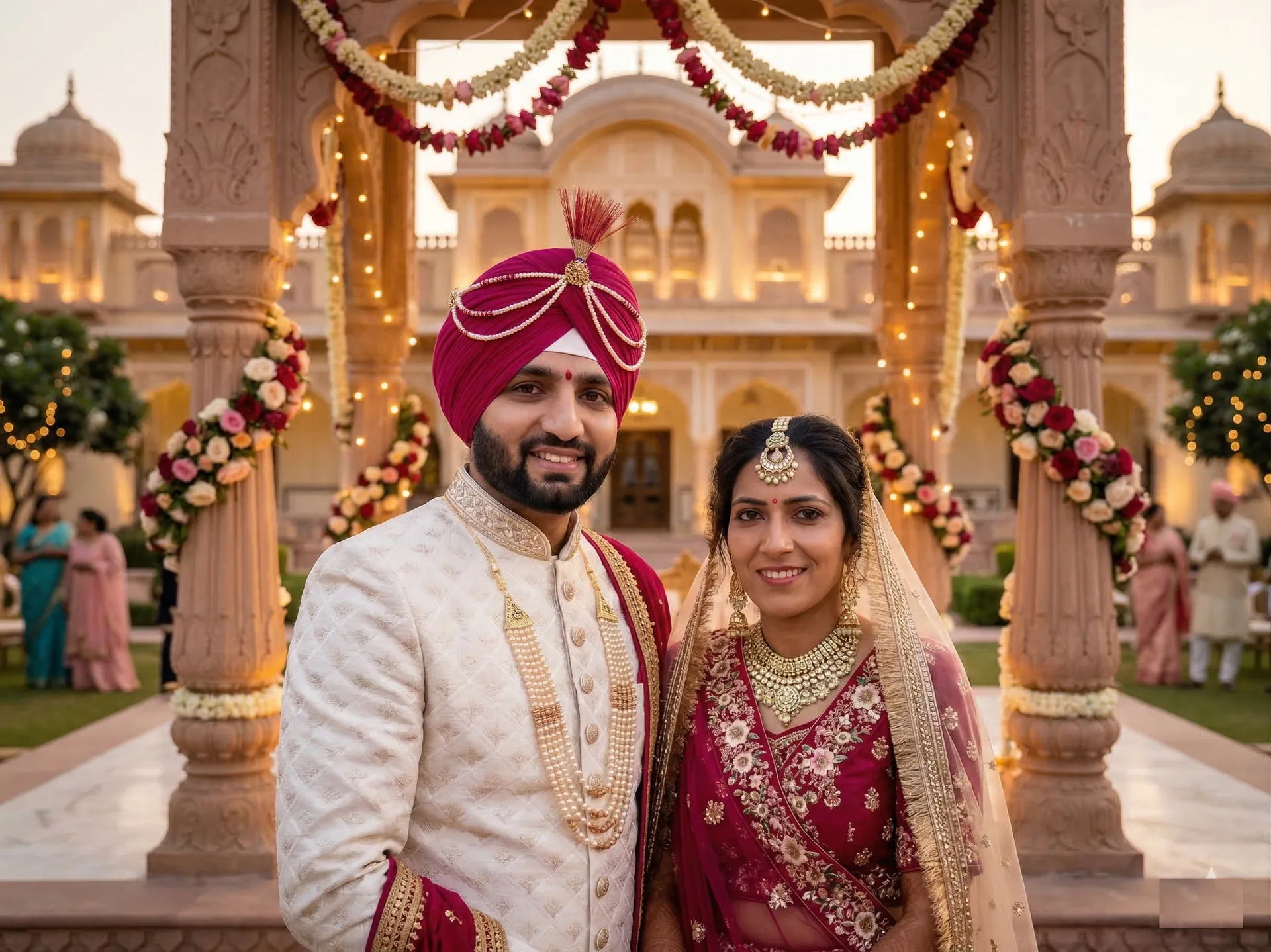
The day the groom’s mother places a red chunni over the bride’s head is also the day two families sit in one room and settle the wedding. Here is what happens, who brings what, and what to agree before anyone arrives.
Somewhere between the rishta being agreed and the wedding week, the groom’s family comes to the bride’s house as a family, carrying a tray. On it is a chunni, usually red, and when the groom’s mother or another senior woman of his side places it over the bride’s head, the room understands that she has been accepted into that household. Families call it chunni chadhana, chunni chadana or simply “the chunni”, and in many homes it is folded into the sagai on the same afternoon.
It looks like a ceremony about a scarf. In practice it is the first long sitting between two families who will spend the next few months negotiating dates, halls, guest numbers and a dozen smaller things, and it is often the day those things are actually settled. This article covers the ceremony itself, the hosting, and the conversation that happens over the tea afterwards. Practice varies by family, by district and between Sikh and Hindu households, and where it does, we say so.
What the chunni means, and what it does not
The gesture is simple. The groom’s side covers the bride’s head with a chunni they have brought, and with it they take her into their family. The accounts of Punjabi weddings agree on that much, and on the fact that it is the groom’s family’s gift and the groom’s family’s gesture: the bride’s side receives and hosts.
It is not a legal step and it is not, by itself, the engagement. In some families the rings are exchanged on the same day and the chunni is part of the sagai; in others the chunni comes first, on its own visit, and the sagai follows later or is skipped. What the roka and the sagai each commit the two families to is covered in a separate article on roka and sagai, and it is worth reading alongside this one, because the chunni borrows some of the weight of whichever ceremony it is attached to.
Nor is there one correct version. Two Kamboj families from districts a few hours apart can hold the chunni at different points, with different people present, and each will consider theirs the ordinary way. The useful question to ask the other side early is not “how is it done?” but “how do you do it?”.
Where it sits: with the sagai, before it, or close to the wedding
The three arrangements below are the ones families most often describe. None is more proper than another; what matters is that both sides know which one they are holding.
- On the same day as the sagai, at the bride’s home or a hall. The groom’s side arrives, the rings are exchanged, and the chunni is placed on the bride in the same sitting (some families put the chunni on first, some after the rings). This is the commonest pattern where both families live within a day’s drive of each other.
- As its own visit, after the roka. The groom’s family comes specifically to place the chunni and bring the bride’s clothes and jewellery, weeks or months before the wedding. The sagai may be held separately or folded into the wedding week.
- In the wedding week itself. When half the family is flying in, the chunni is often held a day or two before the wedding, sometimes on the same day as the mehndi. It loses nothing by being late, but it does lose its use as the day to settle arrangements, because by then everything is already settled.
In a Sikh family, and in a Hindu family
In Sikh households the engagement, where one is held, centres on the boy. The SGPC’s code of conduct says a marriage need not be preceded by an engagement at all, and that if one is held there should be a congregational gathering, an ardas before the Guru Granth Sahib, and a kirpan, a steel kara and some sweets may be given to the boy. That is the kurmai on the groom’s side. The chunni is the parallel gesture towards the bride, and Sikh families who keep it commonly hold an ardas before it, either at the bride’s home or at a gurdwara, so that the chunni follows a prayer rather than standing on its own.
In Hindu households a pandit may conduct a short puja at the bride’s home before the chunni and the rings, and the sagai often includes a tikka on the groom’s forehead from the bride’s father or brother. Whether the pandit is there at all varies a good deal: some families treat the chunni as a purely domestic, women-led occasion and keep the priest for the wedding itself.
Where a Sikh family and a Hindu family are marrying, decide early whose form the day takes, or whether it takes both. The considerations are much the same as for the wedding itself, which the article on Sikh and Hindu families marrying across traditions works through.
Who comes from the groom’s side
The core is the groom’s parents and grandparents, his sisters and their husbands, his brothers and bhabhis, and the senior aunts — the bua, the chachi or taai — because the chunni is placed by the women and the women of his side are the ones who will be meeting the bride as family for the first time. Many families also bring the groom’s mama and mami, and the uncles from his father’s side.
Whether the groom comes is one of the things that genuinely differs. In some families he comes, sits beside the bride once the chunni is on, and the couple are fed sweets together. In others he stays home, and the visit is the elders’ and the women’s. Neither is a slight. Ask, and do not read meaning into the answer.
Numbers are the first practical question, and the one most often left vague. The bride’s side is the host, and it is planning food, seating and return gifts for a specific number of people. “We will bring close family” means something different in every household. The groom’s side should give a figure, and keep to it.
What the groom’s side brings
The gifts travel in a decorated thaal or on several trays. What is on them is the groom’s family’s choice, and the bride’s family should not ask for anything in particular.
- The chunni itself. Red is the commonest colour, pink is frequent, and it is usually heavy with gota or embroidery. In some families it is a phulkari, sometimes one that has been in the family for a generation.
- Clothes for the bride: a suit, a lehenga or a sari, often in the same colour as the chunni. Some families send the outfit a day or two ahead so the bride can wear it for the ceremony; others bring it on the day and she changes.
- Jewellery, often a set given by the mother-in-law, who may fasten it on the bride herself once the chunni is on.
- Sweets, dry fruit and fruit, in boxes or baskets, for the bride’s household.
- The ring, if the sagai is being held the same day.
- Shagun for the bride, given in an envelope by the elders after the chunni is placed.
The ceremony itself, in the order it usually runs
The sequence below is the shape most families follow. Details are moved around, added and dropped freely, and nothing goes wrong if yours differs.
- The bride’s family receives the groom’s side at the door and seats the elders first.
- In a Sikh family, an ardas. In a Hindu family, a short puja where a pandit is present.
- The bride is brought in by her sisters, cousins or bhabhis and seated, usually in the outfit sent by the groom’s family.
- The groom’s mother, or the senior woman of his side, places the chunni over the bride’s head. In many families the other women of his side touch the chunni or add their own blessing.
- Jewellery is put on her, often by the mother-in-law and sisters-in-law. If the sagai is the same day, the rings are exchanged here.
- The bride is fed a sweet, and in turn touches the feet of the groom’s elders, who give her shagun.
- The bride’s family gives its return gifts to the groom’s relatives, often in order of age.
- Photographs, and then the meal.
How the bride’s family hosts
The chunni is the bride’s family’s first time hosting the groom’s side as family rather than as visitors, and the hosting is noticed. That is not a reason to overspend. It is a reason to get a few specific things right.
Home or hall. A home is warmer and costs less, and in a village or a town where the house has a courtyard it is the natural choice. A hall makes sense when the numbers are large, the house is small, or the families are meeting halfway between two districts. A gurdwara’s hall, where the ardas is being held there anyway, is a third option many Sikh families use.
The meal. Agree beforehand whether it is a full meal or tea, and if the day includes an ardas, ask rather than assume what the groom’s family expects on the menu and on the table. Some households keep a religious function strictly vegetarian and without alcohol; others make no distinction. Finding out afterwards is the awkward way round.
Return gifts. The bride’s side usually gives something to the groom’s close relatives — clothes, sweets or shagun in envelopes — handed over in order of age. Keep these modest and consistent, and keep a written list of who received what. You will want the same list again at the milni, and the two families will compare.
One person at the door. Name one member of the bride’s family, usually an uncle or a brother-in-law, whose job is to receive the groom’s side, seat the elders and keep an eye on the clock. When everyone is a host, nobody is.
What gets decided over the tea
Once the chunni is on and the photographs are done, the elders of both sides tend to sit together. This is where most of the wedding is actually arranged, and it goes better if both families arrive knowing what they want to settle.
- The wedding date, or the window of dates. A Hindu family may need the pandit’s muhurat first; a Sikh family will mainly need the gurdwara’s availability. Bring both families’ constraints, including relatives who must travel.
- The ceremony: an Anand Karaj, a Hindu wedding with pheras, or both. The Anand Karaj article and the article on the pheras cover what each involves, and which questions to put to the gurdwara or the pandit.
- Venues, for the wedding and for the functions each side will host.
- The size of the baraat. This is the number the bride’s side will feed, seat and receive at the milni, and it is the one most likely to grow if it is not fixed now.
- Which functions each family holds, and where. Mehndi, maiyan and the jaggo usually run in both homes in parallel, and the two timetables need to be kept in step, which the article on those days, linked at the end of this one, covers.
- Who will be the contact on each side for the rest of the planning. One name each.
Gifts, and where they stop being gifts
The chunni is a day of gifts in both directions: the groom’s side brings jewellery and clothes, the bride’s side gives return gifts and shagun. None of that is the problem. The problem starts when one side begins to describe what the other side “will of course be giving” at the wedding, or compares the jewellery that arrived with what was expected.
A demand for money, goods or property in connection with a marriage is dowry, and giving, taking or demanding dowry is an offence under the Dowry Prohibition Act, 1961, whatever words it is dressed in. If it comes up at the chunni, it has come up early enough to deal with. There is an article on refusing a dowry demand without wrecking the relationship, and it is worth reading before the day if there is any sign of it.
The gifts that are given freely are better recorded. A short written list of what was given, by whom and to whom, protects both families later and costs ten minutes.
Families in different places
Distance changes the chunni more than tradition does. When the two families are in neighbouring districts, the groom’s side comes for the afternoon and goes home. When one family is in the canal belt around Sri Ganganagar and the other is a day’s travel away, the groom’s side may need to stay the night, and the bride’s family is then hosting breakfast and beds as well as a ceremony. Say so plainly when the date is set.
When one family is abroad, the chunni is the ceremony most often compressed or moved. Some families hold it in the wedding week; others hold it in India with the parents present and the groom joining on a video call; a few hold a small version abroad and a fuller one in India. None of these is wrong. What causes friction is one side assuming the chunni will be a full gathering and the other planning a quiet family visit. The NRI Kamboj matrimony guide covers the wider planning questions families abroad run into.
The frictions that come up, and how to head them off
- The numbers grow. Twenty becomes forty on the morning. Fix the figure when the date is fixed, and if it has to change, the groom’s side should say so days ahead, not at the gate.
- The groom’s side arrives late. The bride has been dressed and seated for an hour, the food is cooling and the bride’s elders are waiting. Agree an arrival time and phone ahead if it slips.
- Nobody said whether the groom was coming. One family laid a place beside the bride; the other left him at home. Ask.
- The chunni or the jewellery becomes a comparison. Somebody mentions what a cousin received. It is said lightly and remembered for years. Elders on both sides can stop this with a single sentence, and should.
- Arrangements made over tea are remembered differently a month later. Write down the date, the venues, the baraat size and the contacts before the groom’s side leaves, and send a copy to the other family the same evening.
- Photographs go on social media before both families are ready. Agree when the news is to be shared and by whom, particularly if the sagai has not been held yet.
A short list for the week before
- Confirm which ceremony this is: the chunni alone, or the chunni with the sagai.
- Confirm the number of people coming, and whether the groom is among them.
- Confirm the arrival time, and the name and phone number of one person on each side.
- Decide on the ardas or the puja, and arrange the granthi or pandit if you need one.
- Agree the meal, and ask about the menu rather than guessing.
- Prepare the return gifts and a written list of them.
- Write down what both families want to settle — date, ceremony, venues, baraat size — so it actually gets discussed.
After the chunni
From here the wedding runs on its own momentum. The days before it, with maiyan, mehndi, the jaggo and the choora, are covered in mehndi, maiyan and choora; the groom’s side’s next visit, this time with the baraat, is in the baraat and the milni; and the step-by-step overview of Kamboj wedding rituals puts every ceremony in order on one page.
If there is one thing to take from this article, it is that the chunni is the easiest point in the whole process to agree things. Both families are in one room, in good humour, with the elders present. Use the afternoon.
Sources
- Sikh Rehat Maryada (The Code of Sikh Conduct and Conventions), Article XVIII, Anand Sanskar — Shiromani Gurdwara Parbandhak Committee, Amritsar
Clause (f) says a marriage need not be preceded by an engagement ceremony, and that where one is held there should be a congregational gathering and an ardas before the Guru Granth Sahib, after which a kirpan, a steel kara and some sweets may be given to the boy. Supports the paragraph on the engagement in Sikh families.
- Dowry Prohibition Act, 1961 — Government of India
Makes giving, taking or demanding dowry an offence. Supports the section on where gifts stop being gifts.
Our team answers every message. Reach out and we will sort it out.