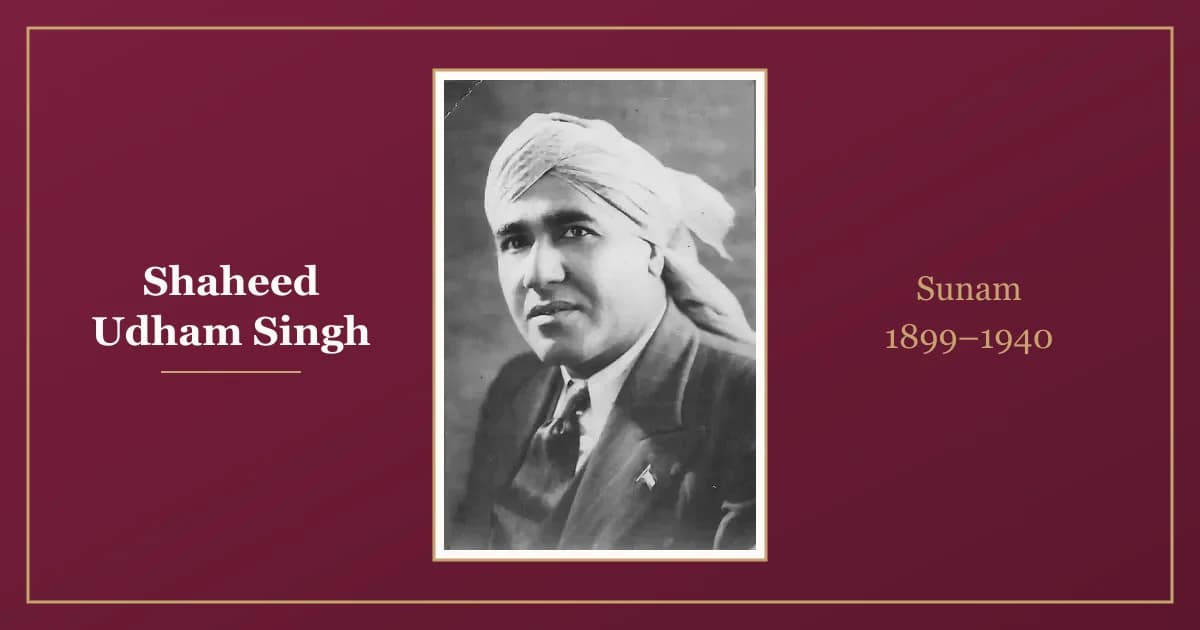
Born Sher Singh in Sunam, raised in an Amritsar orphanage, he shot Sir Michael O’Dwyer in London in 1940 and was hanged at Pentonville. His family, his life and his return home.
Udham Singh was the revolutionary from Sunam who shot dead Sir Michael O’Dwyer, the former Lieutenant-Governor of Punjab, at Caxton Hall in London on 13 March 1940. He was born Sher Singh into a Kamboj family of the Jammu gotra, lost both parents before he was eight, and grew up in the Central Khalsa Orphanage in Amritsar. He spent most of his adult life abroad working for the Ghadar movement, served four years in Punjab’s jails, and in 1934 went to England. Six years later he fired six shots in a crowded meeting hall, made no attempt to escape, was tried at the Old Bailey and was hanged at Pentonville Prison on 31 July 1940, aged forty. In 1974 his remains were brought home and cremated in Sunam, and the town has carried his name ever since: Sunam Udham Singh Wala.
This article follows the biography published in Sunam in 2024 by Giani Jangir Singh Ratan, who travelled with the procession that carried his remains home in 1974. It draws on the family tree, the government records and the jail letters reproduced in that book. Where other accounts tell part of the story differently, the article says so at the end.
Family and ancestry
The book places the family firmly in Sunam: five generations of his father’s line had lived in the town, in Mohalla Raipurian near the Patwar Khana, and that ancestral house still stands. The family was Kamboj by community and Jammu by gotra, and the book records the line on both sides.
- Name at birth: Sher Singh.
- Born: 26 December 1899, in Sunam, then in the princely state of Patiala and today in Sangrur district.
- Gotra: Jammu. Community: Kamboj.
- Father: Tehal Singh Kamboj, known as Chuhar Singh before he took amrit. He worked first as a labourer on the Nilowal canal and, from 1905 to 1907, as the gateman at the Upli railway level crossing on the Sunam–Sangrur line.
- Mother: Narain Kaur, also called Harnam Kaur, the daughter of Boota Singh of the Dhot gotra.
- Elder brother: Sadhu Singh, born in 1897.
- Ancestral house: Mohalla Raipurian, near the Patwar Khana, Sunam.
The family tree
The book prints his kursinama, the family genealogy, and a 2016 version attested by the village revenue officials agrees with it. On his father’s side the line runs from Diya Ram Jammu to Sedu, from Sedu to Haria, and from Haria to three sons, Ram Dial, Jodh Singh and Nathha. Jodh Singh’s sons were Wasau and Badhau. Wasau was the father of Kakku and of Tehal Singh, and Tehal Singh was the father of Sadhu Singh and Udham Singh. Badhau’s line ran through Nikku to a daughter, Aas Kaur, who would become the most important person in Udham Singh’s family story after his death.
On his mother’s side the line runs from Jati Singh Dhot to Gulab Singh and then to Boota Singh, whose children were Jiwa Singh, Narain Kaur and Mehtab Singh. Jiwa Singh, his maternal uncle, was among the relatives he went to see on his last visit to Sunam in 1932, and the book lists Jiwa Singh’s son Bishan Singh and his children as well.
An orphan in Amritsar
His mother died in Sunam in 1905 and his father in October 1907. On 24 October 1907 the two boys were taken to the Central Khalsa Orphanage, the Putlighar, in Amritsar, by Ragi Chanchal Singh Kamboj, a kinsman from Sunam. They were entered in its register as numbers 121 and 122. The orphanage had both brothers take amrit at the Akal Takht, and with it came new names: in the book’s account Sadhu Singh became Mukta Singh, and Sher Singh became Ude Singh, the name that became Udham Singh.
The orphanage taught trades as well as reading. Udham Singh learned to play the harmonium and tabla and to sing gurbani, and he learned carpentry, blacksmith’s work, painting and electrical work, skills that kept him in work across three continents. His brother died of pneumonia in 1917, and in 1918 he passed his matriculation examination from Punjab University, Lahore. The book traces his politics to these years, to the Sikh history he read, to the Ghadar Party, and to the leaders of the Punjab movement of the day, among them Dr Saif-ud-Din Kitchlew, Dr Satya Pal and Lala Lajpat Rai.
Jallianwala Bagh, 13 April 1919
On the afternoon of 13 April 1919 some twenty thousand unarmed people gathered in the Jallianwala Bagh in Amritsar to protest against the Rowlatt Act and the arrest of Kitchlew and Satya Pal. Brigadier-General Reginald Dyer marched in with about ninety soldiers and, without warning, had them fire 1,650 rounds into the crowd in about ten minutes. The Hunter Commission counted 379 dead and more than 1,200 wounded, and the book notes that 42 of the dead were children. The province was then governed by Sir Michael O’Dwyer, whom the book holds responsible for the repression in Punjab that year.
The book’s account is that young Udham Singh was in the Bagh that day, serving water to the crowd for the orphanage, that he saw the firing, and that while searching for the body of Ratan Devi’s husband afterwards he was hit by a bullet in the left arm. It says he took up a handful of earth soaked with the blood of Hindu, Muslim and Sikh dead and swore he would not rest until the massacre was avenged and India was free. The wound took him home to Sunam to heal, and there he sent for his cousin Aas Kaur, whom he had not seen for years.
Abroad, and the Ghadar Party
After 1919 he spent most of his life outside India. The book lists the places he lived and worked for the cause: Basra, East Africa, Egypt, France, Switzerland, Germany, Mexico, California, Chicago and Detroit. In 1924, living in San Francisco, he became an active member of the Ghadar Party, the movement of Punjabi emigrants in North America working to end British rule in India. In July 1927, on the party’s instructions, he sailed back to Punjab with weapons and ammunition for its members.
Arrest and four years in jail, 1927 to 1931
On the evening of 30 August 1927 the City Kotwali police in Amritsar arrested him with the arms and a quantity of Ghadar literature; the book says three pistols and 139 cartridges were recovered. The case was registered under section 20 of the Arms Act, and on 1 October 1927 he was sentenced to five years’ rigorous imprisonment.
He served the sentence in the jails of Multan, Peshawar, Rawalpindi, Mianwali and Lahore, where he was set to work at the oil press and at pounding munj grass, and where he met political prisoners including Harnam Singh Chamak and Karam Singh Dhoot. He was in Multan jail when the news came that Bhagat Singh, Rajguru and Sukhdev had been hanged on 23 March 1931; he had admired Bhagat Singh and called him his guru. He was released on 23 October 1931, after four years, one month and twenty-four days, and went straight to Hussainiwala to pay homage to the three.
A last visit to Sunam
In May 1932 he came home to Sunam for the last time. The book describes him arriving clean-shaven, in English clothes and tinted glasses, on a red motorcycle, so changed that his friends did not know him at first. He saw his maternal uncle Jiwa Singh, his cousin Aas Kaur and friends such as Captain Bachan Singh. When Aas Kaur offered to arrange his marriage if he would stay, he refused: he would not marry, he told her, because he had a great task still to do. As he left he pressed a fistful of rupees into her hand.
The police knew him as Sher Singh and Ude Singh, so on 20 March 1933 he obtained a new passport at Lahore in the name of Udham Singh, number 52753, and early in 1934 he sailed for England. The book says that in 1933 he also met Subhas Chandra Bose.
England, and the names he used
From 1934 he lived in London, with journeys out to Europe. In 1936 he travelled to Leningrad and Moscow and on through Poland, Latvia and Estonia, returning to England on 25 June 1936, and he went out again through Berlin and the Baltic before coming back to London in 1938. The book presents these journeys as a search for help for Indian freedom from countries opposed to Britain. His last address was 8 Mornington Terrace, near Regent’s Park.
He moved under many names. The book lists Sher Singh, Ude Singh, Udham Singh, Udhan Singh, Shibdu Singh, Azad Singh, U. S. Sidhu and Frank Brazil, and above all Muhammad Singh Azad, the name he insisted on after his arrest; the government genealogy also records Ram Muhammad Singh Azad. The meaning was deliberate. A Hindu, a Muslim and a Sikh name stood side by side, closed with azad, free, and he signed his letters from prison M. S. Azad.
Caxton Hall, 13 March 1940
On 12 March 1940, the book says, he was at the India Office on passport business when he saw a notice for a meeting the next afternoon. The East India Association and the Royal Central Asian Society were to meet at 3 pm in the Tudor Room of Caxton Hall in Westminster, and the speakers included Lord Zetland, the Secretary of State for India, Sir Louis Dane and Lord Lamington, both former governors, and Sir Michael O’Dwyer himself. It was twenty-one years since Jallianwala Bagh.
He came dressed like an English gentleman, in a striped suit and hat, with his revolver hidden inside a book. As the meeting broke up he fired six shots. In the book’s account:
- Sir Michael O’Dwyer, aged 75, was hit twice and died where he fell.
- Lord Zetland was hit twice in the left side of his ribs.
- Sir Louis Dane was hit in the right arm.
- Lord Lamington was shot through the right hand.
Arrest and trial
He made no attempt to run. The book says he could have escaped and chose not to, because he wanted the dock as a platform, and that he smiled at the press photographers as he was led away. The next morning, 14 March, he was brought before the Chief Magistrate at Bow Street and remanded to Brixton Prison. In his pocket was a diary for 1940. On its first page he had written about action as the only way to open the door of India’s destiny; against 13 March he had noted the time and place of the Caxton Hall meeting; on later pages he wrote that he had seen the whole world and now wanted only to see India free.
He asked his friends to spend nothing on his defence, but members of the Indian community in London raised money anyway, and V. K. Krishna Menon was among the lawyers who acted for him. The trial was heard at the Central Criminal Court, the Old Bailey, before Mr Justice Atkinson. On 5 June 1940, after the verdict, he read out a statement of eight handwritten pages for about twenty-five minutes and ended with slogans against British imperialism. He was sentenced to death. The book says he answered the sentence with an Urdu couplet, tegon ke saaye mein pal kar jawan hue, ik khel jaante hain phaansi par jhool jaana: we grew up in the shadow of swords, and to swing from the gallows we count a game. The judge ordered that his statement should not be published.
His friends appealed against his wishes, and the appeal was dismissed on 15 July 1940. A petition for mercy signed by 365 Sikh, Hindu, Muslim and English men and women was rejected as well, and he had wanted no part of it: to him, putting the word mercy next to his name insulted his honour and that of every other revolutionary, and the money, he said, would be better spent on educating poor children. His last wish was that his body should be sent home to Sunam.
Pentonville, 31 July 1940
He was hanged at Pentonville Prison at nine in the morning on Wednesday 31 July 1940. His friends asked for his body so that he could be cremated with proper rites, and were refused. He was buried inside the prison grounds, near the grave of the revolutionary Madan Lal Dhingra, with the initials U.S. cut into a stone in the wall beside the grave.
Brought home in 1974
For thirty-four years people in Sunam and across Punjab asked for his remains. The turning point was the Punjab government’s recognition of his cousin Aas Kaur as his legal heir, after which Chief Minister Giani Zail Singh and the Government of India asked the British government to return them, and Britain agreed. A Punjab delegation went to London, and the casket reached Palam airport in Delhi on 19 July 1974. Wrapped in the tricolour, it lay in state at Kapurthala House for three days, where Prime Minister Indira Gandhi laid a wreath.
On 23 July the casket left Delhi in a decorated vehicle, and a procession led by Zail Singh carried it through Haryana, Chandigarh, Ludhiana, Jalandhar, Amritsar, Ferozepur, Bathinda, Sangrur and Patiala. It reached Sunam on 31 July 1974, the thirty-fourth anniversary of his hanging. After a great gathering in the town’s Olympic Stadium, the casket was placed on a sandalwood pyre on a raised platform, and at three in the afternoon Zail Singh lit it.
The ashes were gathered on 2 August and divided between places sacred to all three of the faiths his chosen name had joined:
- Haridwar: on 3 August 1974 the ashes were immersed in the Ganga at Har ki Pauri, with the police reversing arms. Two of Aas Kaur’s sons, Khushi Nand and Bachan Singh, attended for the family.
- Kiratpur Sahib: Aas Kaur herself went out by boat with the party and placed the ashes in the Sutlej.
- Jallianwala Bagh: an urn was taken in procession to Amritsar and installed in the memorial gallery at the Bagh.
- Rauza Sharif, Sirhind: an urn was buried at the Sufi shrine.
- Sunam: ashes were used in the 27-foot memorial built on the cremation ground, and urns were kept at the Shaheed Udham Singh Government College and for the town’s memorial.
His family after him
Udham Singh never married and had no children, so his family line continues through his relatives in Sunam, and above all through Aas Kaur. She too had been orphaned young, when plague killed her parents in 1906, and the two orphans of the family stayed close; in a letter from Brixton he asked that his people, especially his sister, be told to forget him. At the final ardas on 11 August 1974, Zail Singh honoured her with a tamra patra, called her his sister by faith, and granted her a pension for life, which a Punjab government order of July 1975 fixed at 250 rupees a month for the cousin sister of Shaheed Udham Singh.
Aas Kaur had six children: Punni Kaur, Khushi Nand Singh, Bachan Singh, Bachni Kaur, Inder Kaur and Inder Singh. The 2016 genealogy reproduced in the book carries her line down through several more generations of grandchildren and great-grandchildren, the living family of Shaheed Udham Singh in and around Sunam today.
How Sunam remembers him
- The name. At the 1974 ardas Zail Singh announced that Sunam would become Sunam Udham Singh Wala; the notification was issued on 26 February 2006.
- The ancestral house in Mohalla Raipurian was declared a protected memorial on 1 September 2000.
- A 27-foot memorial column stands on the cremation ground in the Shaheed Udham Singh Olympic Stadium.
- A life-size bronze statue was unveiled at Kainchian Chowk on the Bathinda road on 31 July 2008.
- A memorial and museum on the Sunam–Bathinda road, whose foundation stone was laid on 25 December 2016, was dedicated on 31 July 2021. Among the things it shows are a trunk he made with his own hands and his mother Narain Kaur’s hand mill.
- India issued a postage stamp in his name in 1992, and the government took over the Shaheed Udham Singh college in Sunam, as Zail Singh had promised in 1974.
Where other accounts differ
- His date of birth. The book, like most Sikh and Punjabi reference works, gives 26 December 1899. Colonial records, and the passport he took out in 1933, give 1901.
- Jallianwala Bagh. The book says he was present and wounded; several historians, Kim Wagner and Anita Anand among them, consider his presence unproven.
- His brother’s names. The book says Sadhu Singh became Mukta Singh at the orphanage; some reference works give the change the other way round.
- The sentence of 1927. Five years in the book’s account, of which he served just over four; some accounts give four years.
Sources
- Giani Jangir Singh Ratan, Krantikari Yodha Shaheed Udham Singh Kamboj: Sankhep Jiwan Birtant (Revolutionary Warrior Shaheed Udham Singh Kamboj: A Brief Life Account), in Punjabi and Hindi — Sunam Udham Singh Wala, 2024
The basis of this article: his family and ancestry, the family tree and the 2016 genealogy, the orphanage years, the book’s account of Jallianwala Bagh, his Ghadar work, the 1927 arrest and his years in jail, his travels and names, Caxton Hall, the trial, his letters from prison, the execution, the 1974 return and division of the ashes, the 1975 pension order for Aas Kaur, and the memorials in Sunam.
Our team answers every message. Reach out and we will sort it out.
